
A CEO's Practical Guide to Adopting Generative AI (Version B — Use Case Prioritization)
A CEO's practical guide to adopting Generative AI (Version B — Use Case Prioritization): how to identify, evaluate, and prioritize the right AI use cases that deliver the fastest and highest business value.
ARTIFICIAL INTELLIGENCE
Video Guru
6/27/20268 min read
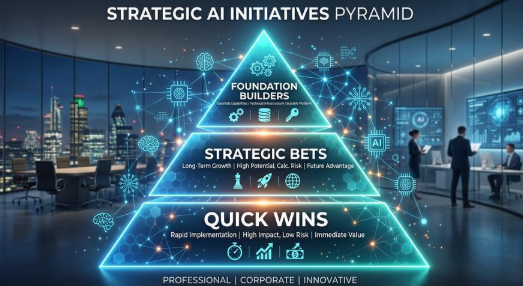
Most generative AI adoption strategies fail before they even begin. Not because the technology doesn't work, but because CEOs try to boil the ocean—piloting too many use cases across too many departments with no clear sequence. I've watched leadership teams burn six months and seven figures on initiatives that produced nothing except frustrated employees. What separates companies gaining real competitive advantage from those spinning their wheels is a disciplined approach to GenAI use case prioritization that matches ambition with organizational readiness.
The "Where to Start" Problem
Here's what I see repeatedly at Roth AI Consulting: leadership recognizes generative AI's potential, approves a budget, then greenlights five to eight pilots simultaneously. Six months later, two have limped into production, three stalled in IT review, and the rest died from ambiguity about who owns them.
The root cause isn't lack of vision. It's lack of sequencing.
Think of generative AI adoption like constructing a building. You don't install penthouse windows before pouring the foundation. Yet that's exactly what happens when companies chase flashy use cases without establishing the data infrastructure and governance to sustain them. My S•I•C•T framework helps teams think through this systematically. The Information layer—identifying signal versus noise in your data and workflows—determines which use cases will deliver value. The Transformation layer reflects your organization's capacity to absorb change, which is almost always the binding constraint CEOs underestimate.
The question isn't "Where can we use AI?" That's a recipe for chaos. The right question is "Where should we start, in what order, and why?"
The 3-Tier AI Use Case Framework
I've developed a practical AI use case framework that sequences initiatives across three tiers: Quick Wins, Strategic Bets, and Foundation Builders. Treat them as sequential, not parallel.
Tier 1: Quick Wins (30 Days)
Quick Wins are individual productivity apps requiring minimal integration, presenting near-zero compliance risk, and delivering visible time savings. These aren't transformative initiatives. They're confidence builders.
The best Quick Wins target individual rather than team workflows, leverage existing tools, involve non-sensitive data, and have clear before-and-after metrics. Common examples include executive drafting assistance, meeting transcription and summarization, code completion for engineering teams, and initial research synthesis. A marketing director using generative AI to draft blog outlines saves two to three hours per week. These aren't revolutionary outcomes. They're meaningful, measurable, and create organizational appetite for deeper investment.
Governance at this tier is light: acceptable use policies, approved tools, basic prompt engineering training, and a channel for employees to share what's working. I've seen companies lock everything down with procurement reviews and legal sign-offs that take months. That's a mistake. Quick Wins need quick deployment. Your risk mitigation is that these tools touch individual workflows, not customer-facing systems or proprietary datasets.
What I watch for at this stage is the Information signal emerging from early adopters. Which teams are experimenting productively? Which use cases are generating genuine enthusiasm versus compliance theater? This intelligence becomes critical input for Tier 2 decisions.
Tier 2: Strategic Bets (90 Days)
Strategic Bets move from individual productivity to team-level transformation. These initiatives require cross-functional coordination, modest integration work, and clear executive sponsorship. They're where generative AI adoption strategy begins producing competitive differentiation rather than just operational efficiency.
The best candidates have three attributes: well-documented workflows bottlenecked by content or analysis generation, decent data availability, and owners credible enough to secure resources and navigate organizational resistance.
Examples that deliver value: customer support response drafting integrated with your CRM, content generation tied to brand guidelines, RFP response automation, and preliminary legal document review. A SaaS company I advised implemented AI-assisted support responses pulling from their knowledge base. Average handle time dropped 34% in the first quarter, but more importantly, agent satisfaction increased as they spent time on complex problem-solving instead of repetitive inquiries.
For organizations in competitive digital markets, Strategic Bet selection should connect to your overall digital strategy. Understanding how link building agencies find backlink opportunities can inform whether AI-assisted content creation fits your portfolio. Similarly, resource page link building creates sustainable authority that AI content workflows should support. If you're in SaaS, mapping link building strategies for SaaS companies against your acquisition model clarifies where AI content fits your growth equation.
The 90-day timeline is intentional. At day 30, confirm technical feasibility. At day 60, pilot users should generate real output with human oversight operational. By day 90, measure business impact and decide whether to scale, refine, or sunset.
Tier 3: Foundation Builders (6 Months)
Foundation Builders are the enterprise capabilities that make sustained, responsible AI scale possible. They're not sexy and don't produce viral demos. But they're what separates companies that capture lasting advantage from those whose early wins crumble under governance gaps and data fragmentation.
These include: unified data architecture with proper lineage, AI governance frameworks covering model selection and risk classification, LLMOps infrastructure, workforce development programs, and integration of AI into core product design.
This is where the Transformation dimension of my S•I•C•T framework becomes the binding constraint. Every organization has a change absorption limit. Push beyond it, and you'll see growing resistance from middle management, compliance incidents, and talent attrition among your most capable people.
The companies that get this right pace Foundation Builders according to organizational maturity, not competitive pressure. Some need six months; others need twelve. The question isn't how fast you can check boxes—it's how fast you can build durable capability without breaking the operational excellence that funds these investments. Understanding how professional backlink strategies drive long-term SEO growth provides a useful analogy: both require compounding investments, patient execution, and infrastructure that supports sustained performance rather than short-term spikes.
The Sequencing Principle
The critical discipline most CEOs miss: these tiers are sequential dependencies, not a menu.
Quick Wins build organizational literacy and surface insights about where value lives. Strategic Bets convert that learning into function-level capability. Foundation Builders create the architecture to scale responsibly.
I've seen companies start with Foundation Builders—hiring chief AI officers, establishing governance committees—before any use case has proven value. I've also seen companies stuck in perpetual Quick Win mode while competitors restructure around AI-native workflows. The right cadence depends on your starting point. What doesn't vary is the sequence.
Governance Through the Tiers
Each tier requires different governance intensity. Quick Wins need policy clarity and tool approval. Strategic Bets need executive sponsorship, defined success metrics, and integration into existing workflows. Foundation Builders need board-level visibility, dedicated investment, and cross-functional ownership spanning IT, legal, risk, and business operations.
I recommend establishing a lightweight AI steering committee at the Strategic Bet stage that evolves into a formal governance body as Foundation Builders scale. This isn't about bureaucracy—it's ensuring decisions about model selection, data usage, and deployment standards are made by people who understand both the technology and your business context.
The Information discipline matters enormously. At every tier, maintain a simple dashboard tracking operational metrics (adoption, usage, efficiency), business metrics (revenue impact, cost reduction), and risk metrics (incidents, compliance status). Review monthly at the executive level. The technology moves too fast for quarterly governance.
Red Flags That You're Moving Too Fast
Speed is the enemy of sustainable AI adoption when it outpaces your capacity to absorb change:
Multiple Strategic Bets launching before Quick Wins produce measurable learning
Foundation Builders starting before any Strategic Bet reaches production
Your executive team can't articulate specific business outcomes for each initiative
Frontline managers confused about what's approved, experimental, or expected
Growing backlog of AI-related security, privacy, or compliance reviews
When you see two or more, throttle the pipeline until your Transformation capacity catches up. If you need external perspective on building this roadmap, explore strategic advisory services that align AI investments with business outcomes rather than technology trends.
Putting It Into Practice
If you're starting this journey, here's what I recommend for your next 30 days:
First, inventory your current state. What AI tools are employees already using without approval? What data assets are accessible? Where are your biggest bottlenecks involving content generation or analysis?
Second, identify three to five Quick Wins—individual productivity apps needing minimal IT support and low risk. Assign owners. Give them 30 days.
Third, establish one Strategic Bet for quarter two. Choose where your Quick Wins reveal the strongest signal: highest enthusiasm, clearest metrics, most credible champion.
Fourth, identify the Foundation Builder representing your biggest constraint. For most mid-market companies, it's data architecture. For regulated industries, it's governance. Be honest about where you're weakest—that's where unmanaged scaling creates catastrophic risk.
The Long Game
Generative AI isn't a quarter or a year of transformation. It's a decade-long restructuring of how knowledge work gets done. The CEOs who navigate this successfully sequence investments based on organizational readiness, measure business outcomes rather than activity, and build foundations before scaling.
The chaos you need to avoid isn't technical failure. Most AI pilots work well enough. The chaos is organizational—initiatives pulling in different directions, governance playing catch-up, talent burning out, and boards losing confidence just when returns materialize.
A disciplined AI use case framework doesn't slow you down. It ensures the speed you achieve is sustainable. That's the difference between adopting generative AI and actually benefiting from it.
FAQ: CEO Guide to Generative AI Adoption
1. How do I know if my organization is ready for generative AI adoption?
Assess three factors: data accessibility (can teams access data they need?), digital workflow maturity (are core processes digitized?), and leadership bandwidth (do you have C-level sponsors?). Organizations with basic cloud infrastructure, digitized processes, and one champion can start Quick Wins immediately. Those missing all three should invest in digital foundations first.
2. What's the biggest mistake CEOs make when prioritizing AI use cases?
Choosing based on technology excitement rather than business pain. The phrase "wouldn't it be cool if..." leads to solutions in search of problems. Start with workflows where teams are constrained by content generation, analysis capacity, or response time. Address pain points people already complain about—not aspirations that sound impressive in presentations.
3. How many Quick Wins should we run simultaneously?
Three to five maximum, targeting different functions so you learn across the organization. Ten Quick Wins with no learning system is expensive chaos. Three with disciplined feedback capture is a strategic foundation.
4. How do we measure success at each tier?
Quick Wins: time saved, adoption rate, employee satisfaction. Strategic Bets: business metrics tied to the function (response time, content throughput, sales cycle length), quality scores from human oversight, and ROI. Foundation Builders: compliance posture, data readiness, time-to-deployment for new AI features, and AI literacy assessments. Each tier has different criteria—don't cross-apply them.
5. What role should the CIO versus business unit leaders play?
Business unit leaders own use case selection and outcome accountability. The CIO owns infrastructure, security, integration, and governance. The CEO or designated sponsor owns sequencing and change capacity. When CIOs own use case selection, you get technically sound solutions that miss business context. When business units ignore IT, you get shadow deployments creating compliance nightmares.
6. How do we handle employees who fear AI will replace them?
Be direct about what you're automating. Most generative AI handles first drafts, routine analysis, and repetitive communication—augmenting human judgment, not replacing it. Involve employees in pilot design so they shape how AI enters their workflow. Share stories of roles that became more interesting after AI took over tedious work. Be honest: some roles will change significantly. Trust built through transparency determines whether people engage productively.
7. Should we build AI capabilities internally or buy them?
For Quick Wins, buy—the market has excellent tools requiring no development. For Strategic Bets, use a hybrid approach: buy the foundation, customize integration, build only where competitive differentiation requires it. For Foundation Builders, you need internal capability because governance, data architecture, and risk management are context-specific. The more important question: do you have organizational capacity to absorb whatever you procure?
8. How do we avoid getting locked into a single AI vendor?
Design for interoperability from the start. Use APIs rather than embedded proprietary workflows. Maintain data in transferable formats. Avoid long-term contracts during the experimental phase. As you move to Foundation Builders, develop internal standards for model evaluation not tied to any single vendor. The vendor landscape shifts rapidly; flexibility today is optionality in two years.
9. What's a realistic budget for phased generative AI adoption?
For mid-market companies ($50M-$500M revenue), Quick Wins require $10K-$50K. Strategic Bets run $100K-$500K including integration and change management. Foundation Builders are $500K to several million depending on data debt and governance starting point. The sequencing framework protects you from parallel initiatives consuming resources without producing learning.
10. How do we keep up with how fast AI technology is changing?
You don't keep up with everything—maintain strategic awareness of what's relevant to your prioritized use cases. Assign one person or small team to monitor developments and assess whether they change your sequencing. Review monthly, not continuously. The signal-to-noise ratio in AI news is terrible. What matters is discerning which developments change the feasibility or economics of your specific initiatives. That's an Information discipline, not a speed-reading competition.