
AI Visibility & Generative Search (Version B — Measurement Framework)
AI Visibility & Generative Search (Version B — Measurement Framework): practical metrics and frameworks to measure and optimize your brand’s performance in AI-powered and generative search environments.
ARTIFICIAL INTELLIGENCE
Video Guru
6/27/20268 min read
Your brand could be invisible to the fastest-growing search channel on earth — and your current analytics wouldn't show it.
Here's the uncomfortable truth I've been raising with leadership teams since late 2024: traditional SEO dashboards tell you nothing about whether ChatGPT, Perplexity, Gemini, or Claude mention your company when prospects ask buying questions. Zero. The reports you reviewed last quarter cover Google rankings, traffic curves, and backlink counts. They don't cover generative search citations, LLM brand mentions, or share of voice inside AI-generated answers.
CEOs who ignore this blind spot are making strategic decisions based on incomplete market intelligence. The good news: measuring AI visibility is entirely doable. Let me walk you through what actually works.
Why Traditional SEO Metrics Miss the AI Story
Google Analytics won't tell you if Perplexity recommended your competitor over you. Search Console doesn't track whether ChatGPT's response to "best enterprise CRM" cites your white paper or your rival's. Your link building reporting KPIs matter enormously for traditional search. But generative search operates on entirely different mechanics.
LLMs don't "rank" websites. They synthesize training data, retrieval-augmented generation inputs, and real-time search results into coherent answers. Your brand either surfaces in that synthesis or it doesn't.
I've sat in boardrooms where marketing teams presented 15% organic traffic growth while their brand was being systematically excluded from AI answers in their highest-value category. Both were true. Only one was being tracked.
The Four Pillars of AI Visibility Measurement
Effective AI visibility measurement rests on four operational pillars: benchmark prompts, citation tracking, share of voice analysis, and dashboard consolidation. Let's examine each.
1. Building Your Benchmark Prompt Library
You can't measure what you don't query. The first step in any serious effort to track brand in AI answers is constructing a disciplined prompt library that reflects how your prospects actually use AI tools.
Start with your existing keyword research — the intent-based queries you've already mapped. Then layer in conversational variants. People don't prompt ChatGPT the way they type into Google. "Best B2B accounting software" becomes "I'm scaling a SaaS company to 100 employees, what accounting software should I actually use?"
I recommend organising prompts into three tiers:
Direct brand queries: "What does [YourCompany] do?" — tests brand recall and factual accuracy
Category ownership queries: "Best [category] for [use case]" — tests competitive positioning
Problem-aware queries: "How do I solve [pain point]?" — tests whether your content feeds into AI recommendations
Run these monthly across the major LLMs: ChatGPT (with browsing), Perplexity, Gemini, Copilot, and Claude. Log the responses. Look for patterns. This manual baseline is labour-intensive but irreplaceable — it builds organisational intuition that automated tools alone cannot provide.
2. LLM Citation Tracking: Finding Where AI Gets Its Answers
This is where measurement gets genuinely interesting — and genuinely challenging. When an LLM cites a source, that's a signal. When it doesn't cite anyone and still answers accurately about your market, that's a different signal entirely.
LLM citation tracking currently requires a hybrid approach. For LLMs with explicit source links — Perplexity, Copilot, Gemini — you can programmatically extract cited URLs and check for your domain. For models without explicit citations, analyse response content for brand mentions and product references.
Several emerging tools specialise in this space, running prompt sets across multiple LLM APIs, extracting mentions and citations, and tracking changes over time.
I treat citation frequency as a leading indicator of information ecosystem influence. When an LLM consistently cites your research or thought leadership, it's a sign that your professional backlink strategies are driving long-term SEO growth that transcends traditional search. The same authority signals that earn editorial links also train LLM retrieval systems to trust your content.
One caveat: LLM citation behaviour is inconsistent. The same prompt can yield different sources as models update and retrieval corpora shift. You're looking for directional trends, not absolute precision.
3. Share of Voice in LLM Responses
Share of voice has been a marketing metric for decades. In generative search, it requires redefinition.
Traditional share of voice measures your ad impressions or organic rankings against competitors. In LLM contexts, it measures how frequently and favourably your brand appears in AI-generated answers relative to your competitive set.
I calculate this across three dimensions:
Mention frequency: Out of 100 relevant category prompts, how many include your brand? How many include each competitor?
Position quality: When mentioned, are you the primary recommendation, one of several options, or an also-ran?
Descriptive accuracy: Does the LLM describe your capabilities correctly? Mischaracterisation is surprisingly common — I've seen companies described as offering services they've never provided, or pigeonholed into segments they've outgrown.
Link building agencies that build real publisher relationships have a structural advantage here. The same publisher authority that drives backlink quality also increases the probability that LLMs will encounter and reference your brand. The measurement system and the visibility system are connected.
Track your share of voice monthly. Graph it alongside traditional SEO metrics. The divergence between the two lines tells a story your board needs to hear.
4. Building Your AI Visibility Dashboard
Raw measurement data without consolidation is noise. CEOs need dashboards that translate AI visibility signals into decision-ready intelligence.
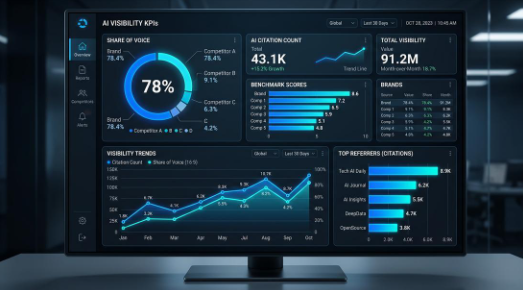
Think of these as your generative search KPIs — the equivalent of rankings and traffic for the AI answer era. Your AI visibility dashboard should integrate four data streams:
Benchmark prompt results: Structured outputs from your monthly manual prompt testing — brand mentions, positioning, accuracy scores
Automated LLM monitoring: API-driven tracking of mention frequency, citation rates, and sentiment trends across major models
Citation source analysis: Which of your content assets are being referenced? Product pages, research reports, documentation, executive commentary?
Competitive intelligence: The same metrics for your top three competitors, enabling relative performance assessment
I recommend starting simple. A spreadsheet with consistent monthly entries outperforms an elaborate dashboard that never gets updated. As your maturity increases, graduate to dedicated tools. But maintain the discipline of regular human review.
The dashboard should answer one question above all: Is our brand becoming more or less visible in AI-generated answers over time?
The S•I•C•T Lens: Why Measurement Requires Organisational Foundation
In my Roth AI Consulting practice, I evaluate AI readiness through the S•I•C•T framework: Structure, Information, Cohesion, Transformation. AI visibility measurement sits at the intersection of all four.
Structure determines who owns this metric. Without clear ownership, measurement doesn't happen. I've seen AI visibility fall between silos — SEO teams lack LLM expertise, AI teams lack marketing context, and leadership misses the gap entirely.
Information is the raw material. Your measurement is only as good as the prompt library you build. Invest in understanding how customers actually use AI tools before you start counting mentions.
Cohesion matters because AI visibility is cross-functional. Content marketing, PR, and product documentation all influence whether LLMs encounter your brand signals. Fragmented team efforts produce fragmented presence.
Transformation is the long game. Winners treat AI visibility as a capability to build, not a one-off audit. They learn which content formats LLMs prefer and iterate based on measurement feedback — the same discipline that separates market leaders from laggards in every technology transition.
From Measurement to Action
Measurement without response is expensive navel-gazing. Once your AI visibility dashboard reveals gaps, you need a response playbook.
If your brand is rarely mentioned, investigate your information ecosystem. Are you publishing original research? Featured in authoritative publications? AI-assisted reputation strategies for global companies can accelerate this, but the fundamental requirement is producing content worth citing.
If your brand is mentioned but mischaracterised, update your owned properties and engage publisher relationships that clarify positioning. Consider structured data markup that helps LLMs understand your offerings correctly.
If competitors dominate share of voice, analyse their citation sources. What are they publishing that you're not? Competitive intelligence in generative search follows the same principles as traditional SEO — understand the landscape, identify gaps, execute deliberately.
The services that specialise in building this visibility are increasingly integrating generative search intelligence into their offerings. The measurement discipline I've described lets you evaluate whether those services are actually moving the needle.
The CEO's Role in AI Visibility
This isn't a topic to delegate and forget. CEOs should understand three things:
First, your current marketing KPIs are incomplete. They may show excellence in traditional channels while a generative search gap widens monthly. Ask your marketing leadership: "What's our share of voice in ChatGPT and Perplexity for our top ten category queries?" If the answer is silence, you have a measurement problem.
Second, AI visibility compounds. Brands establishing presence now are training LLM retrieval systems to prefer them. Late movers face accelerating disadvantage as information ecosystems develop gravitational pull around early authoritative sources.
Third, this is strategically knowable. The CEOs who treat AI visibility as a mysterious black box will cede ground to competitors who treat it as a managed performance metric.
The question isn't whether your brand appears in AI answers. It's whether you know — and whether you're acting.
Frequently Asked Questions
1. How is AI visibility measurement different from traditional SEO reporting?
Traditional SEO tracks rankings, traffic, and backlinks from search engines like Google and Bing. AI visibility measurement tracks whether and how your brand appears in answers generated by large language models like ChatGPT, Perplexity, Gemini, and Claude. The mechanics differ entirely — LLMs synthesise information rather than rank pages, so you need to measure mentions, citations, and positioning within generated responses rather than keyword positions and click-through rates.
2. What tools can I use to track brand mentions in AI answers?
Current options include specialised AI visibility platforms, custom API integrations, and manual benchmark testing protocols. I recommend starting with a structured manual approach — running a defined prompt library monthly across major LLMs and logging results — before investing in automation. This builds organisational understanding that informs tool selection.
3. How often should we benchmark our AI visibility?
Monthly benchmarking strikes the right balance for most organisations. LLM behaviour changes continuously as models update, retrieval systems shift, and browsing capabilities evolve. Quarterly cycles miss important inflection points; weekly cycles create noise without proportional insight. Monthly tracking with quarterly trend analysis gives leadership actionable intelligence without overwhelming operational teams.
4. Which LLMs matter most for B2B brand visibility?
For B2B contexts, prioritise ChatGPT (with browsing enabled), Perplexity, Gemini, and Copilot. Claude matters for certain technical audiences. The relative importance varies by industry and customer segment — if your buyers are developers, include specialised tools they use. Start with the four majors and validate against your customer research.
5. Can we influence whether LLMs mention our brand?
Yes, but indirectly. LLMs reference brands based on their training data and retrieval sources. You influence this through the same activities that build traditional authority: publishing original research, earning coverage in respected publications, maintaining comprehensive documentation, and developing recognised expertise. Strategic link building and publisher relationships compound this effect by increasing the authority signals that LLM retrieval systems prioritise.
6. What should I do if an LLM is describing my company incorrectly?
Start by auditing your owned properties — website, documentation, social profiles — for outdated or ambiguous information. Then expand to publisher relationships: are third-party sources propagating inaccurate descriptions? Consider structured data implementation that clarifies your offerings. For significant inaccuracies, some platforms have feedback mechanisms, though response rates vary. The most reliable correction path is publishing clearer, more authoritative information that eventually influences model training and retrieval.
7. How do I get started with AI visibility measurement on a limited budget?
Begin with a simple spreadsheet and a 20-prompt benchmark library covering direct brand, category, and problem-aware queries. Run these manually across four LLMs monthly. Log brand mentions, positioning, and any citations. This costs nothing beyond time and establishes a baseline that justifies further investment. Many organisations I advise started exactly this way and had meaningful directional data within 60 days.
8. Should AI visibility metrics be included in our regular marketing reporting?
Absolutely. AI visibility should appear alongside traditional SEO, paid search, and social metrics in your marketing dashboard. The goal isn't to replace existing KPIs — it's to complement them with intelligence about a channel that's growing in importance. I recommend a separate AI visibility section that reports monthly with quarterly trend commentary. This keeps leadership informed without creating noise.
9. How do citation patterns in LLMs relate to our backlink profile?
They're correlated but distinct. Strong backlink profiles from authoritative domains increase the probability that LLMs will encounter and cite your content. However, LLMs also draw from training data and real-time browsing that don't map directly to backlink databases. Think of your backlink profile as one input among several — important, but not determinative.
10. What's the biggest mistake organisations make with AI visibility?
Treating it as a one-time audit rather than an ongoing measurement discipline. I've seen companies commission expensive AI visibility assessments, receive a snapshot report, and file it away. Three months later, everything has changed — model updates, new competitors entering the conversation, shifting citation patterns. AI visibility requires the same ongoing attention as your traditional search performance. The measurement framework is the beginning of a practice, not the end of a project.