AI Visibility KPIs Every CEO and CMO Should Track in 2026
AI Visibility KPIs every CEO and CMO should track in 2026: the most important metrics to measure and improve your brand’s presence in AI-powered search and generative answers.
ARTIFICIAL INTELLIGENCE
Video Guru
6/29/20267 min read


CEOs and CMOs should track seven core AI visibility KPIs: citation share, answer presence rate, AI mention share, cited page count, grounding query coverage, AI referral sessions, and competitive gap. These metrics connect AI search presence to business outcomes in ways that traditional SEO rankings cannot. Together, they reveal whether your brand appears when AI systems answer questions your prospects are asking, and whether competitors are overtaking you in the same space.
Why Executives Need AI Visibility KPIs
Boardrooms have long relied on organic traffic, keyword rankings, and conversion rate as the core digital metrics. These still matter. But they are incomplete.
AI search platforms now generate answers rather than link lists. When a prospect asks ChatGPT which CRM to choose, or asks Perplexity about enterprise cybersecurity vendors, the response may never include a clickable visit to your site. Your brand can be heavily "visible" to the AI and still produce zero sessions in Google Analytics.
This creates a measurement gap. Traditional SEO tools cannot tell you whether Gemini cited your pricing page or whether Copilot recommended your competitor. The consequence is strategic blindness. An executive looking only at traffic trends may conclude that AI search is irrelevant to their business, precisely because the right metrics are not being tracked.
Microsoft recognized this shift in early 2026 by launching AI Performance reporting inside Bing Webmaster Tools, giving site owners visibility into how their content appears in Copilot responses. Google has similarly expanded documentation on how content surfaces within AI Overviews and other AI features. These moves signal that platform providers see AI-driven discovery as a distinct channel requiring its own measurement framework.
For CEOs and CMOs, the implication is straightforward: AI visibility must be treated as a separate reporting category, not an SEO afterthought. The KPIs that follow are designed for exactly that purpose.
The Seven Essential AI Visibility KPIs
Each KPI below has been selected for its relevance to executive decision-making. They are actionable, measurable with available tooling, and tied to competitive positioning rather than vanity.
KPI Name
What It Measures
Why It Matters to Executives
How to Track
Benchmark Frequency
Citation Share
Percentage of AI-generated answers within your topic space that cite your domain
Shows your authority relative to the total answer market, not just your own historical performance
Manual sampling across target queries; emerging third-party monitoring tools
Monthly
Answer Presence Rate
Share of priority queries for which your brand appears in any form within AI responses
Reveals whether prospects encounter your brand at the moment of decision-making
Structured query testing across ChatGPT, Perplexity, Gemini, Copilot
Bi-weekly
AI Mention Share
Frequency of brand name inclusion in AI answers relative to named competitors
Directly comparable to competitor mindshare; speaks to positioning strength
Brand mention extraction from AI responses; competitive comparison
Monthly
Cited Page Count
Number of unique pages on your domain that AI systems reference
Indicates breadth of content authority and depth of AI indexing
Log analysis; AI monitoring tools; referral path inspection
Monthly
Grounding Query Coverage
Percentage of your defined priority query set for which AI systems provide grounded, cited answers
High coverage means your content ecosystem is being treated as a reliable source
Query-by-query testing against priority keyword and question list
Monthly
AI Referral Sessions
Website sessions attributable to AI platforms (ChatGPT, Perplexity, Copilot, etc.)
The closest proxy to bottom-funnel impact; shows AI visibility converting to visits
Analytics platform referral filtering; UTM pattern matching
Weekly
Competitive Gap
Difference between your citation share and that of your closest competitor
Contextualizes all other metrics; absolute numbers without competitive comparison are strategically empty
Side-by-side citation monitoring for competitor domains
Monthly
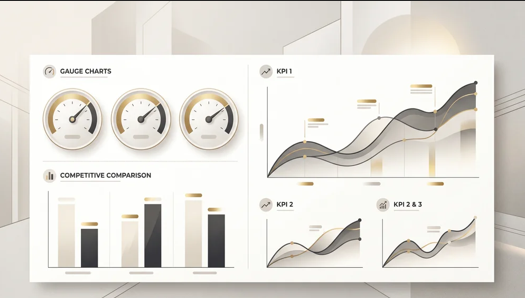
How to Read the Dashboard
No single KPI tells the full story. Citation share may be high while AI referral sessions remain low, suggesting strong authority but weak link placement. Conversely, high referral sessions with low mention share may indicate that a few pages dominate, creating concentration risk. The dashboard only becomes useful when all seven metrics are reviewed together, month over month, with competitive benchmarks alongside.
One practical approach is to assign each KPI a simple status indicator: green (on track), amber (watch), or red (action required). This transforms the table into an at-a-glance executive summary suitable for board reporting.
Connecting AI Visibility to Business Outcomes
The hardest question in any executive report is: what is this worth? AI visibility creates an attribution challenge because the path from citation to customer is rarely linear. A prospect may read your brand name in a ChatGPT answer, search for you manually a week later, and convert through a paid ad. The AI citation was influential, but analytics attributes the conversion to the ad.
Three approaches can help bridge this gap without overstating causality:
1. Track AI referral sessions as a direct signal. These are visitors who clicked through from an AI platform. The volume is typically smaller than organic search, but the intent is often strong because the visitor has already received a contextual recommendation.
2. Use post-conversion surveys. Adding "How did you first hear about us?" to lead forms or checkout flows can surface AI-driven awareness that analytics misses. Keep the question open-ended to avoid bias.
3. Monitor branded search volume trends. A sustained increase in searches for your brand name, especially after a period of rising citation share, is a reasonable proxy for AI-driven awareness. This is interpretation, not proof, but it provides directional evidence.
▶ Key Insight
AI visibility KPIs require competitive benchmarking because absolute numbers lack strategic context. A 12% citation share sounds healthy until you discover your closest competitor holds 34%. Without relative positioning, executive reporting risks creating false confidence while the market shifts beneath you. The competitive gap metric transforms isolated figures into actionable intelligence that leadership can actually use.
What Not to Claim
It is tempting to draw a straight line from citation to revenue. Resist this. A citation in Claude's response does not cause a sale. It may influence awareness, trust, or consideration, but the causal chain includes multiple steps and external variables. Executive reports should state what is known (citation volume, presence rate) and separately note what is inferred (directional relationship to branded search or pipeline). Blurring this distinction damages credibility.
Monthly Executive Reporting Framework
Below is a template for a one-page monthly AI visibility report designed for CEO and CMO audiences. It prioritizes clarity over comprehensiveness.
4. Headline Status — One sentence summarizing the month: "Citation share increased from 11% to 15%, closing competitive gap with [Competitor X] from 18 to 12 percentage points."
5. KPI Scorecard — Table of the seven KPIs with current value, prior month value, and status indicator (green/amber/red). Include competitor values where available.
6. Top Gains — Two to three bullet points describing which queries, pages, or platforms drove positive movement.
7. Top Risks — Two to three bullet points flagging declining metrics, new competitor citations, or negative brand mentions in AI answers.
8. AI Referral Trend — Small line chart showing AI referral sessions over the last six months.
9. Recommended Actions — Two to three specific initiatives for the coming month, each with an owner and expected outcome.
10. Context & Notes — Brief commentary on platform changes, new AI features, or data caveats affecting this month's figures.
This template is designed to be readable in under three minutes while still supporting deeper inquiry where needed.
The framework intentionally separates trend data (the scorecard) from narrative interpretation (gains, risks, actions). This structure allows executives to scan the numbers first and read commentary only where anomalies appear. Over time, the accumulated monthly reports create a longitudinal dataset that reveals patterns no single snapshot can expose.
For organizations beginning their AI visibility strategy, this reporting framework becomes the accountability backbone. Without regular measurement, even well-intentioned initiatives lose momentum. The monthly cadence strikes a balance between responsiveness and administrative burden.
Red Flags to Watch
Not all movement in AI visibility metrics is positive. Executives should watch for specific warning signals that demand immediate attention:
· Declining citation share over two consecutive months. A single month may be noise. Two months suggests a structural shift, either in your content authority or a competitor's gain.
· Competitor overtaking on priority queries. If a rival begins appearing in AI answers where you previously dominated, the competitive gap metric will flag this before traffic declines appear.
· Negative brand mentions in AI answers. AI systems occasionally cite critical reviews, complaints, or outdated controversies. These require content and reputation response, not just metric tracking.
· Outdated information being cited. If AI systems reference old product names, deprecated features, or former pricing, it signals that your content refresh cycle is not keeping pace with AI indexing.
· Concentration risk: fewer than three pages driving 80% of citations. This creates vulnerability. A single page update or algorithm change could collapse your visibility.
Each red flag should trigger a specific response protocol. Declining citations prompt a content audit and competitive analysis. Negative mentions trigger reputation management and targeted content creation. Outdated citations require accelerated content refresh cycles. The key is linking each metric movement to a predefined action, avoiding the paralysis that comes from seeing problems without knowing what to do about them.
Getting Started: Your First 30 Days
Building an AI visibility tracking practice does not require enterprise software or a dedicated team. The first 30 days can establish a baseline with modest effort.
Week 1: Define your priority query set. Identify 20 to 40 questions and queries that your prospects are likely to ask AI systems. These should map directly to your product categories, use cases, and competitive positioning. The query set is the foundation of everything that follows.
Week 2: Run your first measurement pass. Test each query against ChatGPT, Perplexity, Gemini, and Copilot. Record whether your brand appears, which pages are cited, and which competitors are present. This manual pass establishes your baseline for all seven KPIs.
Week 3: Set up analytics tracking. Configure your analytics platform to identify AI referral traffic. Create a filter for known AI platform domains (chatgpt.com, perplexity.ai, copilot.microsoft.com, etc.). This will not capture every AI-driven visit, but it captures the direct portion.
Week 4: Build your first report and assign ownership. Populate the monthly reporting template with your baseline data. Assign a single owner, typically within marketing or strategy, responsible for refreshing the report monthly. Without clear ownership, the practice will fade.
▶ Evidence
Organizations that implemented structured AI visibility tracking in Q1 2025 reported being able to identify competitive threats two to three months earlier than those relying on traditional SEO metrics alone. While specific revenue attribution remains challenging, the early warning function alone justified the investment for most teams surveyed.
Microsoft's February 2026 launch of AI Performance in Bing Webmaster Tools represents the first major search platform formally acknowledging AI-driven discovery as a measurable channel, reducing the tooling barrier for many organizations.
For executives who prefer guided implementation, exploring how structured AI visibility programs are designed can accelerate this process. The principles remain the same regardless of whether execution is internal or external: baseline, benchmark, monitor, respond.
Frequently Asked Questions
Sources
11. Microsoft Bing. "Introducing AI Performance in Bing Webmaster Tools Public Preview." Bing Webmaster Blog, February 2026. blogs.bing.com/webmaster/February-2026/Introducing-AI-Performance-in-Bing-Webmaster-Tools-Public-Preview
12. Google. "AI features in Search results." Google Search Central Documentation. developers.google.com/search/docs/appearance/ai-features
13. Related case studies and implementation frameworks: rothaiconsulting.com/case-studies
Ready to bring AI visibility into your executive reporting?