
Digital Transformation in the AI Era (Version B — 10 Warning Signs)
Digital Transformation in the AI Era (Version B — 10 Warning Signs): recognize the early signals that your transformation is going off track and learn how to correct course before it's too late.
DIGITAL TRANSFORMATION
Video Guru
6/27/202610 min read
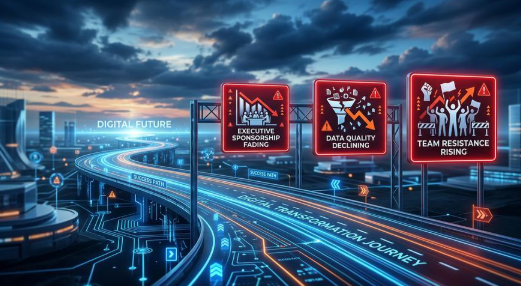
Most AI transformations don't fail dramatically. They die quietly — buried under status reports that still say "on track" six months after the last meaningful progress update. I've watched this pattern repeat across organizations of every size: the initial enthusiasm, a promising pilot or two, then a slow drift into mediocrity where nobody can quite say when momentum shifted.
The warning signs are always there if you know where to look. In my experience advising leadership teams through enterprise AI adoption, I've identified ten red flags that signal your transformation is stalling — and more importantly, what each one reveals about the underlying problems you need to fix.
Red Flag #1: Executive Sponsorship Starts Missing Meetings
This is the earliest and most reliable indicator that trouble is coming. Your executive sponsor was at every standup for the first three months. They asked questions. They cleared blockers personally. Now they're "double-booked" for the third review in a row, and their delegate doesn't have decision rights.
What it means: The executive has either lost faith in the initiative or has competing priorities that now feel more urgent. Either way, the initiative has lost its organizational air cover. When budgets get reviewed next quarter, your project becomes an easy cut because leadership attention has already moved on.
What to do: Schedule a candid 30-minute conversation. Don't ask about the project — ask about their confidence level. If it's low, you need to know why. Address their specific concerns head-on or reframe the initiative's scope to rebuild that confidence.
Red Flag #2: Pilots Multiply But Nothing Scales
You have seven AI pilots running. None of them has moved to production. Each team explains their timeline is "just a few more weeks" to validate results. Meanwhile, you've burned through nine months of budget and haven't changed a single customer-facing process.
This is one of the most common AI transformation warning signs I encounter. Organizations get addicted to the safety of pilots because scaling requires hard decisions about infrastructure, governance, and org structure that nobody wants to make.
What it means: Your organization lacks the Structure component of transformation — the architectural decisions, governance models, and role clarity that let proven solutions move from experiment to operational backbone.
Red Flag #3: Data Quality Conversations Keep Getting Postponed
"We'll clean the data in phase two." "The data issues aren't blocking the pilot." "That's a governance problem for later." If you're hearing these phrases regularly, your transformation is building on quicksand.
I worked with a financial services firm that spent fourteen months on a customer churn prediction model only to discover their CRM data had duplicate records for 34% of customers. The model worked beautifully on clean test data. In production, it recommended retaining customers who had already churned — sometimes twice.
What it means: You're missing the Information foundation. The S•I•C•T framework treats data as a strategic asset, not a hygiene factor. When data quality keeps getting deferred, it signals that leadership views AI as a software project rather than an organizational capability.
For organizations serious about data integrity — which directly impacts how AI models perform — the same rigor you'd apply to auditing your backlink profile for risky links should be applied to your data pipeline. Both are foundational assets that deteriorate quickly without regular attention.
Red Flag #4: Business Teams Start Calling AI "IT's Project"
Language reveals alignment gaps faster than any status dashboard. When business stakeholders refer to AI initiatives as "IT's thing" or ask "when will IT deliver the model?" — you've lost the cross-functional integration that makes transformation stick.
AI that delivers real value sits at the intersection of domain expertise, technical capability, and operational reality. When business teams disengage and treat AI as a service they consume rather than a capability they co-own, the resulting solutions solve theoretical problems rather than real ones.
What it means: You're failing on Cohesion. The cultural readiness and shared understanding across teams has broken down. Business stakeholders never bought into ownership, or they were never invited to.
Red Flag #5: Success Metrics Keep Getting Redefined
First the goal was customer acquisition cost reduction. Then it shifted to "insights generation." Now success is measured by "number of models deployed" — regardless of whether those models changed any business outcome.
This metric migration is a classic symptom of digital transformation stalling. When an initiative can't demonstrate real business impact, the definition of success gets watered down until something looks good on a slide.
What to do: Lock your primary metric for the first twelve months. Accept that it might be discouraging in month four. If the metric is right — tied to a real business outcome that leadership cares about — the honesty will force useful conversations about what's actually blocking progress.
Red Flag #6: The Same Technical Debt Gets Re-Discovered Every Quarter
"We need to modernize our data warehouse before we can..." "Our API infrastructure isn't quite ready for..." "We should really consolidate our CRM instances first..." If these statements sound familiar and have been on your roadmap for eighteen months, your transformation is waiting for perfect conditions that will never arrive.
What it means: Your organization lacks Transformation capacity — the ability to learn and adapt while executing. The S•I•C•T framework identifies this as the rate-limiting factor in most transformations. You don't need perfect infrastructure. You need the ability to improve infrastructure while delivering value incrementally.
Red Flag #7: Team Resistance Shifts from Active to Passive
Active resistance is actually healthy. When people argue against an AI initiative, they're engaging with it. The dangerous moment comes when vocal critics go quiet. They haven't changed their minds — they've concluded the initiative will fail on its own, or they've learned that engaging is career-limiting.
Passive resistance looks like compliance without conviction. Teams run the required processes but don't optimize them. They feed models the minimum viable data. They log issues in tracking systems where they know they'll age out.
Address this by identifying the credible skeptics who went silent and asking them privately what they'd need to see to genuinely support the initiative. Their answers will surface real problems your status reports aren't capturing.
Red Flag #8: Your External Vendor or Consultant Is Your Sole Source of Progress Updates
When the only person who can explain what's happening with your AI transformation works for a vendor or consulting firm, you have a structural problem. This arrangement creates perverse incentives — the party being measured is also controlling the measurement.
What it means: You haven't built internal capability. You're not transforming your organization; you're renting someone else's. Sustainable AI adoption requires internal expertise, internal ownership, and internal accountability for outcomes.
If you're relying on external partners to manage how your digital presence and data infrastructure evolve, consider how that same dependency might create risk in other areas of your digital strategy. External expertise accelerates progress, but internal capability ensures continuity.
Red Flag #9: The Original Business Case Assumptions Are Never Revisited
Every AI initiative launches with a business case. Most are never reviewed against reality. The assumptions about adoption rates, data availability, and integration effort that justified the investment sit in a deck somewhere while the actual project diverges further from them each month.
What to do: Schedule a quarterly "business case reality check." Compare original assumptions to actual results. Not to assign blame — to understand where your mental models were wrong and adjust strategy accordingly. Organizations that do this catch problems early. Organizations that don't discover their transformation has stalled when the funding gets cut.
Red Flag #10: "Change Management" Means a Single Training Session
This is perhaps the most telling of all AI transformation red flags. If your approach to organizational change was a town hall announcement, a training deck, and a Slack channel, you didn't manage change. You announced it.
Real transformation requires persistent communication, visible modeling from leadership, incentives aligned to new behaviors, and the hard work of helping people through the uncertainty of learning new ways to work. Training sessions transfer information. Transformation requires behavior change — and behavior change happens through repetition, reinforcement, and seeing others succeed.
The Pattern Behind the Flags
If you recognized multiple flags from this list, the pattern matters more than any individual symptom. Stalled transformations share a root cause: the organization treated AI adoption as a technology implementation rather than an organizational transformation.
Technology implementations have clear requirements, known solutions, and predictable timelines. Transformations are messier. They require simultaneous progress across multiple dimensions — the S•I•C•T framework I use with clients maps these clearly:
Structure: Do you have the governance, roles, and decision rights to support AI at scale?
Information: Is your data treated as a strategic asset with clear ownership and quality standards?
Cohesion: Do teams across functions share understanding and accountability for AI outcomes?
Transformation: Can your organization learn faster than your competitors as the technology evolves?
When I work with leadership teams through Roth AI Consulting, we start by assessing these four dimensions before discussing any specific technology. Because the companies that succeed with AI aren't the ones with the best models. They're the ones with the organizational capability to put good models to productive use — and to keep improving.
What To Do If You're Seeing These Warning Signs
First, acknowledge it. The organizations that recover are the ones where someone has the courage to say "this isn't working" before the situation becomes unrecoverable.
Second, identify which of the four S•I•C•T dimensions is your primary constraint. You probably have gaps in all four, but one is the bottleneck right now. Fix that first.
Third, reduce scope. A smaller initiative that delivers real value and builds organizational confidence beats a broad initiative that delivers nothing but teaches everyone that AI projects don't succeed.
Fourth, bring the skeptics into the solution. The people who identified problems early are often your best source of insight about how to fix them. They're also the people whose buy-in you'll need for the next attempt.
The Bottom Line
AI transformations stall because organizations underestimate the organizational change required and overestimate the technology challenge. The warning signs in this article aren't technical problems — they're organizational signals. Avoiding AI pilot problems requires the same discipline you'd apply to any strategic initiative: clear ownership, honest measurement, and the willingness to confront uncomfortable truths about progress.
The good news is that recognizing these warning signs early gives you time to act. Most stalled transformations can be restarted — but only if leadership is willing to ask hard questions and hear honest answers.
If you're navigating these challenges and want to discuss what genuine transformation looks like for your organization, you can learn more about my work here.
Frequently Asked Questions
How long should an AI pilot run before we expect to see scalable results?
In my experience, a well-designed pilot should demonstrate clear, measurable value within 90 to 120 days. If your pilot has been running longer than six months without a defined path to production, that's a signal to pause and reassess. The question isn't whether the model works — it's whether your organization can operationalize the capability the pilot is testing. If the blocker is technical, that's solvable. If the blocker is organizational, continuing the pilot won't fix it.
What's the most common reason AI transformations stall after successful pilots?
The gap between pilot and scale is where most transformations die. Pilots succeed because they have executive attention, dedicated resources, and hand-picked data. Scaling requires operational processes that work when executive attention moves on, when resources are shared across priorities, and when data is messy. Organizations that don't build operational infrastructure — governance, monitoring, retraining pipelines, decision rights — during the pilot phase find they can't sustain results at scale.
How do I know if our data quality issues are serious enough to block transformation?
There's a simple test: can you produce a report that leadership trusts within 24 hours of being asked? If every data request requires manual cleanup, reconciliation, and caveats about accuracy, your data foundation isn't ready for AI. Models amplify the patterns in your data — including the errors and biases. Start with a targeted data quality initiative on one critical dataset, prove you can maintain it, then expand.
Should we stop our AI initiatives if we see several of these red flags?
Not necessarily. Stopping is rarely the right answer — redirecting is. If you see multiple red flags, the right response is to reduce scope, increase focus, and address the organizational barriers before trying to advance on a broad front. A single use case that delivers real value and builds organizational confidence creates more momentum than five stalled pilots.
How do we maintain executive sponsorship when priorities shift?
Executive sponsorship decays naturally as the novelty of AI wears off and other priorities compete for attention. Counter this by connecting AI initiatives directly to what the executive cares about most right now — not what they cared about when the initiative launched. Update your framing quarterly. Show progress in their language. Make it harder for them to disengage by demonstrating value that's relevant to their current priorities.
What role should external consultants play in AI transformation?
External expertise should accelerate your internal capability, not replace it. Use consultants for skills you don't have and knowledge you haven't built yet — but every engagement should include knowledge transfer as a deliverable. The goal is to need less external support over time, not more. If your consulting spend is increasing six months into transformation, that's a structural problem, not a staffing one.
How do we measure the organizational readiness aspects of transformation?
I recommend assessing across the S•I•C•T dimensions quarterly using structured interviews with stakeholders at multiple levels. Ask the same questions each quarter so you can track trends. Are decision-making processes faster or slower? Is data more trusted or less? Are cross-functional handoffs smoother or more contentious? These qualitative indicators predict transformation success better than technical metrics alone.
Can a transformation recover if team resistance has become passive?
Yes, but it requires a different approach than addressing active resistance. Passive resistance usually signals that people feel unheard or that previous concerns were dismissed. Recovery starts with genuine listening — not to convince people, but to understand. Find the credible skeptics, ask what they'd need to see to support the initiative, and actually incorporate their input. Visibility into how feedback shapes decisions rebuilds trust faster than any communication campaign.
What's the single most important leading indicator of transformation success?
The rate at which decisions get made and executed. Not the quality of individual decisions — the velocity. Organizations that transform successfully make decisions faster, learn from them faster, and adjust course faster. If your AI initiative requires a steering committee meeting to change anything, your decision architecture is the bottleneck. Fix that and everything else accelerates.
How should we think about the timeline for genuine AI transformation?
Real transformation is measured in years, not quarters. But progress should be visible in quarters. The first year should deliver at least one production use case with measurable business value. The second year should show the beginnings of organizational capability — teams requesting AI solutions rather than being assigned them. By year three, AI should be embedded in how the organization operates, not a separate initiative. If you're not seeing quarterly progress toward these milestones, the transformation isn't building momentum — it's stalling.