How Internal Linking Clarifies Entities, Topics and Commercial Services
How internal linking clarifies entities, topics, and commercial services — a practical way to strengthen your E-E-A-T signals and improve visibility in both traditional and AI search.
ARTIFICIAL INTELLIGENCE
Video Guru
6/29/20267 min read
Strategic internal linking clarifies the relationships between entities, topics, and commercial services on a website, helping search engines and AI systems understand what the site is about, which pages are most important, and how concepts connect. Well-placed links with descriptive anchor text function as semantic signals that guide crawlers and AI retrieval systems through a structured knowledge graph.
How Internal Links Communicate Entity Relationships
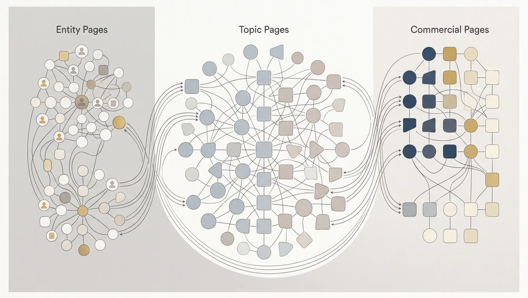
Every internal link is a statement of relationship. When you link from a page about topic clusters to a page about entity optimization, you assert that these concepts are semantically related within your domain's knowledge graph. Crawlers and AI retrieval systems interpret these connections as edges in a semantic graph, where pages are nodes and links define how those nodes relate.
Google's documentation on AI features explicitly recommends making content "easily findable through internal links on your website" as a foundational SEO practice supporting inclusion in AI Overviews and AI Mode. Internal links are discovery mechanisms that help AI systems understand which pages belong together and which concepts reinforce one another.
The anchor text surrounding a link provides the label for that relationship. Descriptive anchor text such as "entity-based navigation structures" gives the retrieval system a semantic annotation. Combined with link context, this forms what researchers call a "semantic triple" that expresses meaning between two ideas. The more your internal links align with real conceptual relationships, the more accurately AI systems can represent your expertise in generated answers.
Internal Linking Architectures for Entity Clarity
Not all internal linking structures communicate entity relationships with equal clarity. Below is a framework comparing three proven architectures for entity clarity and AI visibility.
Architecture
Structure
Strengths
Limitations
Hub-and-Spoke
Central pillar page links to related cluster pages; cluster pages link back to the hub and laterally to related clusters.
Pro Clear topical hierarchy; strong authority concentration on pillar pages; easy for crawlers to discover cluster relationships.
Con Can create authority bottlenecks if hub pages are too few; deep cluster pages may receive diluted signals.
Topic Cluster
Broad topic hub connects to narrowly focused subtopic pages; subtopic pages interlink where semantically relevant.
Pro Mirrors how LLMs organize knowledge; excellent for demonstrating topical depth; supports comprehensive AI citations.
Con Requires ongoing maintenance to prevent cluster drift; interlinking rules must be enforced editorially.
Entity-Based Navigation
Canonical entity pages serve as hubs for specific concepts; all mentions of an entity link to its canonical page using consistent anchor text.
Pro Maximum entity disambiguation; creates explicit knowledge graph signals; strongest architecture for AI retrieval and citation.
Con Highest implementation complexity; requires entity glossary maintenance; may feel unnatural without careful editorial integration.
The entity-based navigation model is particularly relevant for AI visibility. You create canonical hub pages for each key entity in your domain and ensure every mention links back to its canonical page using consistent anchor text. This creates "stable meaning references" that help AI systems disambiguate concepts correctly. Most enterprise websites benefit from a hybrid approach: hub-and-spoke for major service categories, topic clusters for content-heavy sections, and entity-based navigation for disambiguating key terms.
▶ Key Insight
Key Insight for Researchers and Practitioners
Internal links function as entity relationship signals that AI retrieval systems use to understand source context and authority. When a website links informational content to canonical entity pages using consistent, descriptive anchor text, it constructs an explicit knowledge graph that helps language models disambiguate concepts and surface the site as a referenced source in AI-generated answers.
Anchor Text Best Practices for Entity SEO
Anchor text is the primary linguistic signal attached to an internal link. It tells both users and machines what to expect at the destination. For entity clarity, anchor text must be descriptive, varied, and contextually relevant.
Descriptive and Varied
Use anchor text that describes the destination page's content rather than generic phrases. "Learn about our AI visibility methodology" is stronger than "click here" because it embeds entity-relevant terms. Avoid using identical anchor text for every link to the same page. Natural language variation signals authentic editorial linking.
Use Entity Names Naturally
When linking to an entity page, use the entity name as it would appear in natural writing. If your canonical page defines "Generative Engine Optimization," use that phrase or natural variations ("GEO strategies," "optimizing for generative engines") rather than forcing exact-match keywords. Entity names in anchor text reinforce the connection between mentions and canonical definitions.
Avoid Exact-Match Over-Optimization
Repeatedly using identical keyword-rich anchor text triggers spam signals in modern search systems. The safer approach is to distribute anchor text naturally across a spectrum: partial matches, branded terms, descriptive phrases, and occasional exact matches where they fit editorially.
Connecting Informational Content to Commercial Services
The editorial bridge approach connects informational content to commercial service pages through natural transition points. A detailed guide on entity optimization might naturally lead to questions about implementation support. At that point, a contextual link ("Our AI visibility methodology includes entity mapping as a core component") serves both the reader and the site's commercial goals without breaking editorial integrity.
Best practices for commercial-informational linking:
· Link only when the commercial page genuinely answers a question raised by the informational content
· Use transparent anchor text that signals the destination is service-related
· Limit commercial links to one or two per informational page
· Ensure the majority of internal links point to other informational or entity pages
· Monitor engagement metrics to verify commercial links do not increase bounce rates
When informational and commercial content connect through editorially justified links, AI retrieval systems correctly classify the site as an authoritative resource that also offers professional services.
Technical Implementation Tactics
Effective internal linking for entity clarity requires consistent implementation across multiple page elements.
Breadcrumb Navigation
Breadcrumbs encode hierarchical relationships into every page, telling crawlers and AI systems where a page sits within the site's topical structure. A trail such as Home > Services > AI Visibility > Entity Optimization encodes four entity relationships simultaneously. Implement breadcrumbs with BreadcrumbList schema to ensure these relationships are machine-readable.
Related Content Sections
Automated "related content" sections at the end of articles create lateral links between topically similar pages. These work best when powered by semantic similarity rather than simple tag matching, reinforcing genuine conceptual relationships and helping crawlers discover connections they might otherwise miss.
Contextual Inline Links
Links embedded within paragraph text carry the highest semantic weight because they are surrounded by disambiguating context. A contextual link to your entity optimization case studies within a sentence about implementation outcomes provides far more meaning than the same link in a footer. Prioritize contextual inline links for your most important entity relationships.
Footer Links
Footer links serve structural and trust functions rather than topical signaling. Links to About, Contact, Privacy Policy, and Terms help AI systems confirm organizational identity, contributing to E-E-A-T signals. However, footer links carry minimal topical weight because they appear sitewide and lack contextual richness. Do not rely on them for communicating entity relationships.
XML Sitemaps as Supplementary Signals
XML sitemaps provide supplementary discovery signals. A well-structured sitemap that groups URLs by content category helps crawlers understand your site's organization. Include only canonical URLs and use the lastmod tag to signal content freshness.
Common Internal Linking Mistakes
Even experienced SEO teams make recurring mistakes with internal linking that undermine entity clarity.
Orphan pages have no internal links pointing to them. Crawlers cannot discover them through normal link following, and AI systems cannot incorporate them into entity graphs. Every page that should be indexed needs at least one internal link from a page that is itself linked.
Excessive links dilute the value of each individual link. When a page contains hundreds of links, crawlers may stop following them before reaching important destinations, and AI systems may struggle to identify which relationships are meaningful.
Broken chains occur when a series of linked pages contains a dead link or redirect loop. These disruptions fragment the entity graph and prevent authority from flowing through intended pathways. Regular crawling with tools like Screaming Frog or Sitebulb catches broken chains before they accumulate.
No topical hierarchy results from linking everything to everything without structural intent. Flat linking patterns fail to communicate which pages are most important or how topics relate, producing an undifferentiated graph that offers little guidance to AI retrieval systems.
Generic anchor text such as "click here" or "read more" provides no semantic signal about the destination page. Replace these with descriptive phrases that naturally incorporate relevant entity terms.
▶ Evidence
Evidence: Bing AI Performance Dashboard
In February 2026, Bing introduced AI Performance in Bing Webmaster Tools, providing publishers with visibility into how often their content is cited in AI-generated answers. The dashboard tracks total citations, grounding queries, and page-level citation activity. Microsoft noted that clear headings, tables, FAQ sections, and consistent entity representation across formats all help AI systems reference content accurately. This confirms that internal linking architecture directly influences citation likelihood in generative search experiences.
· Total Citations: Number of times content appears as a source in AI answers
· Grounding Queries: Key phrases AI systems use when retrieving cited content
· Page-Level Activity: Which specific URLs are most frequently referenced
Measuring Internal Link Effectiveness
Three categories of metrics reveal whether your linking architecture achieves its entity clarity goals.
Crawl Depth Metrics
Track how many clicks it takes crawlers to reach important pages from the homepage. Critical entity pages and commercial service pages should be reachable within three clicks. Use crawl tools to identify pages that sit too deep and bring them closer through additional internal links.
Internal PageRank Distribution
Tools like Screaming Frog, Sitebulb, and Ahrefs calculate internal PageRank or "internal link score" to show how authority flows through your site. If important entity pages have low internal scores, they need additional contextual links from high-authority pages.
User Engagement Metrics
Analytics data provides indirect signals about internal link quality. Pages with high bounce rates from internal referrals may indicate a mismatch between anchor text expectations and destination content. Pages that drive further exploration signal successful entity relationship mapping. Track session depth and navigation paths to validate linking decisions.
Frequently Asked Questions
Sources
1. Google Search Central. "AI Features and Your Website." Google for Developers, https://developers.google.com/search/docs/appearance/ai-features. Accessed July 2025.
2. Microsoft Bing. "Introducing AI Performance in Bing Webmaster Tools Public Preview." Bing Webmaster Blog, February 2026. https://blogs.bing.com/webmaster/February-2026/Introducing-AI-Performance-in-Bing-Webmaster-Tools-Public-Preview.
3. ZC Marketing. "LLM Internal Linking: 2025 Techniques That Work." https://zcmarketing.au/seo-tips/llm-internal-linking-2025/. Accessed July 2025.
4. Definite SEO. "Internal Linking in SEO: Structure, Authority & AI Context." https://definiteseo.com/on-page-seo/internal-linking/. Accessed July 2025.
Internal linking is the connective tissue of your site's entity graph. When that tissue is weak, AI systems cannot accurately represent what you know.