
Query Fan-Out and Grounding Queries: How Generative Search Finds Sources
Query Fan-Out and Grounding Queries: how generative search actually finds and selects sources — the technical mechanisms behind AI answers in 2026.
ARTIFICIAL INTELLIGENCE
Video Guru
6/29/20267 min read
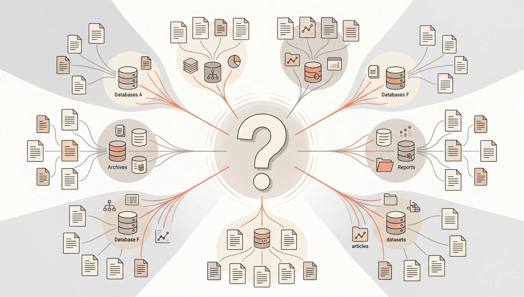
Generative search uses query fan-out to expand a single user question into multiple related queries, then uses grounding queries to retrieve and verify sources from indexed content before synthesizing an answer with citations. Query fan-out generates 5 to 15 related queries from one input. Grounding queries are the actual search strings sent to the index, and they often differ significantly from what the user originally typed. Content that answers the full spectrum of fan-out queries with clear, factual, well-structured statements has the highest probability of being retrieved and cited.
How Query Fan-Out Works
Query fan-out is the process by which a generative search system takes one user question and produces multiple related queries to ensure comprehensive source coverage. The user asks one thing; the system translates it into many.
Consider a user who asks: "What are the best chiptuning services in Budapest?" A generative search system does not run a single search against that exact string. It generates a cluster of related queries designed to retrieve different dimensions of the topic:
· "best chiptuning service Budapest reviews"
· "chiptuning Budapest price comparison"
· "reliable ECU tuning companies Hungary"
· "Budapest chiptuning customer testimonials"
· "chiptuning warranty and reliability Budapest"
· "what is chiptuning and how does it work"
· "chiptuning vs remapping differences"
The fan-out pattern follows predictable structures. Systems typically generate queries that cover definitional angles (what is X?), comparative angles (X vs Y), evaluative angles (best X, reviews of X), locational angles (X in location), and procedural angles (how does X work?). The goal is not to match the user's wording but to maximize the probability of retrieving relevant, authoritative source material across all semantic dimensions of the topic. Published research and documented system behavior suggest ranges from 5 to 15 fan-out queries for typical consumer questions. Each becomes a grounding query.
Grounding Queries Explained
Grounding queries are the specific search strings that AI systems issue to retrieve source material. They are the bridge between the system's internal understanding of what the user wants and the indexed content available on the web.
Grounding queries differ from the original user query in several important ways. First, they are often more specific. Where the user asked "best chiptuning services in Budapest," a grounding query might be "Budapest chiptuning Dyno test results 2025." The system has inferred that performance test data is a relevant dimension and constructed a query to find it.
Second, grounding queries frequently use phrasing the user never employed. The system may translate informal language into more precise terms, convert questions into keyword-oriented retrieval forms, or add temporal and geographic modifiers to narrow results. Content optimized only for exact-match user phrasing may miss retrieval opportunities.
Third, grounding queries are evaluated for retrieval quality. Not every generated query produces useful results. The system assesses the relevance and density of sources returned and may discard queries that retrieve thin or low-authority content. This filtering step is why comprehensive coverage matters: if your content answers only the obvious query, you miss the fan-out queries that the system actually uses. Reason backward from the fan-out patterns: if the system generates definitional, comparative, evaluative, and procedural queries for your topic, your content should address all four categories explicitly.
The Source Selection Pipeline
Once grounding queries have been issued and results retrieved, the system moves through a multi-stage pipeline to select, verify, and synthesize sources. Understanding this pipeline explains why some content is cited and some is ignored despite ranking well in traditional search.
Stage
What Happens
What Content Needs
1. Retrieval
Grounding queries are executed against the search index; candidate documents are returned for each query
Indexability, crawlability, and semantic relevance to the grounding query topic
2. Relevance Scoring
Candidate documents are scored for topical relevance, freshness, domain authority, and structural quality
Clear topical focus, current information, recognizable domain authority, clean HTML structure
3. Fact Verification
Retrieved claims are cross-referenced across multiple sources to identify consistent facts and flag outliers
Factual statements supported by evidence, explicit data points, claims that align with consensus sources
4. Synthesis
Verified facts are combined into a coherent narrative answer tailored to the user's original question
Information that fits logically into a synthesized answer: clear facts, explicit conclusions, quotable phrasing
5. Citation
Sources are attached to specific claims within the generated answer as inline citations
Distinct, attributable statements that the system can map to specific claims in its answer
Content can fail at any stage. A page may be retrieved but score poorly on relevance if its topical focus is diffuse. It may score well on relevance but fail fact verification if its claims are unsupported, or fail citation if its statements are too vague to attribute. This pipeline explains why high traditional search rankings do not guarantee AI citation. The pipelines are connected but not identical.
What Bing's AI Performance Dashboard Reveals
In February 2026, Microsoft launched AI Performance reporting inside Bing Webmaster Tools, giving site owners a window into how their content appears in Copilot responses. The dashboard includes data on grounding queries, specifically which queries led to your content being retrieved and cited.
This is the first major search platform to expose grounding query data at scale. The information comes with important caveats. The dashboard may represent a sample rather than a complete set, and it is specific to Copilot and Bing-powered AI experiences. It does not reflect query fan-out patterns in ChatGPT, Perplexity, Gemini, or other independent systems.
Even with these limitations, content creators can see which grounding queries drive their AI visibility, adjust content to cover those queries more comprehensively, and identify gaps where competitors are being retrieved instead. The dashboard also reports impression-like metrics and click-through data.
Google has not released an equivalent grounding query report, though its AI features documentation describes how content surfaces within AI Overviews. The absence of detailed grounding query data from Google means Bing's dashboard is currently the most concrete source of insight into how a site's content is retrieved through query fan-out.
▶ Key Insight
Content that answers related questions comprehensively is more likely to be retrieved through query fan-out because generative search systems generate multiple grounding queries per user question. A page that covers the primary topic, adjacent comparisons, definitional context, and practical guidance satisfies more fan-out queries than a narrowly focused page, increasing its retrieval surface area across the full citation pipeline.
How to Optimize for Grounding Queries
Optimizing for grounding queries requires shifting from keyword-centric to coverage-centric thinking. The goal is not to rank for one query but to be retrievable for the full spectrum of fan-out queries that AI systems generate for your topic.
1. Map the Fan-Out Query Space. For your target topic, manually generate the 10 to 20 queries an AI system might issue. Include definitional ("what is X"), comparative ("X vs Y"), evaluative ("best X" or "X reviews"), locational ("X in location"), and procedural ("how does X work") variants. This is your retrieval surface area map.
2. Audit Semantic Coverage. Check which fan-out queries your current content addresses explicitly. A passing mention is not coverage. The content must answer the query directly enough to be retrieved and cited. Mark gaps where no page provides a direct answer.
3. Write Clear Factual Statements. AI systems prioritize explicit, verifiable claims. Instead of "industry-leading chiptuning," write "our chiptuning service increases engine output by an average of 25% based on Dyno testing." Factual specificity supports relevance scoring and fact verification.
4. Structure for Synthesis. Use clear headings, concise paragraphs, and explicit conclusions. Content easy to parse into discrete claims is easier to cite. Long narrative passages without factual anchors are harder to attribute.
5. Maintain Freshness and Consistency. Outdated content fails fact verification when newer sources contradict it. Review and update key factual claims regularly.
6. Build Topical Authority Breadth. Cover related subtopics on your domain. If the AI system retrieves your pricing page, it is more likely to also retrieve your warranty page if both exist. Breadth signals domain authority for the topic cluster.
The framework is iterative. As AI systems evolve their fan-out patterns, your content must evolve too. The query space you map in month one will look different in month six.
For teams beginning their AI visibility strategy, the GQOF provides a structured starting point: more grounding queries covered, higher retrieval probability, more citations.
Practical Example: From User Question to Citation
Let us walk through the full pipeline with a concrete example. A user opens Perplexity and types: "best chiptuning service Budapest."
7. User Query Received: "best chiptuning service Budapest"
8. Fan-Out Generation: The system generates 8 related grounding queries:
"chiptuning Budapest reviews 2025""best ECU tuning companies Budapest""Budapest chiptuning Dyno test results""chiptuning Budapest price list""chiptuning warranty Hungary""reliable chiptuning service Budapest customer feedback""chiptuning vs remapping Budapest""what to look for in chiptuning service"
9. Retrieval Phase: Each grounding query is executed against the index. The system retrieves 5 to 10 candidate documents per query.
10. Relevance Scoring: A Budapest chiptuning company's page that includes Dyno test results, pricing, testimonials, and warranty information scores highly across multiple grounding queries. A page that only lists services without supporting data scores lower.
11. Fact Verification: Claims are cross-referenced. If three independent sources confirm a company offers a 2-year warranty, that claim is marked verified. Outliers are flagged.
12. Synthesis: The system constructs an answer: "Based on customer reviews and Dyno testing data, several chiptuning services in Budapest stand out. [Company A] offers a 2-year warranty with demonstrated 25% performance gains..."
13. Citation: Each claim is attributed to the source page that provided the specific, verifiable fact in a clear, structured format.
The cited page wins not because it ranked first for "best chiptuning service Budapest," but because it answered multiple fan-out grounding queries with specific, verifiable facts.
The path to citation runs through query fan-out, not through the original user query. Content that wins answers the questions the AI system asks on the user's behalf.
▶ Evidence
Different AI search platforms exhibit different fan-out behaviors. Perplexity tends toward broader fan-out with more sources. ChatGPT generates fewer but more targeted grounding queries. Gemini's patterns may prioritize fresher content. The GQOF framework accounts for this by recommending broad semantic coverage, improving retrieval probability regardless of a platform's fan-out pattern.
Frequently Asked Questions
Sources
14. Microsoft Bing. "Introducing AI Performance in Bing Webmaster Tools Public Preview." Bing Webmaster Blog, February 2026. blogs.bing.com/webmaster/February-2026/Introducing-AI-Performance-in-Bing-Webmaster-Tools-Public-Preview
15. Google. "AI features in Search results." Google Search Central Documentation. developers.google.com/search/docs/appearance/ai-features
16. Related frameworks and implementation guidance: rothaiconsulting.com/ai-visibility-strategy-geo-sict
Want your content to surface in more AI-generated answers?