
Strategic AI Partnerships (Version A — Evaluation Framework)
Strategic AI Partnerships (Version A — Evaluation Framework): a practical framework to evaluate and select the right AI partners that truly align with your business goals and deliver lasting value.
BUSINESS STRATEGY
Video Guru
6/27/20268 min read

Most AI partnerships fail before the first model is ever deployed. I've watched organizations pour millions into vendor relationships that unraveled six months later over data access disputes, misaligned expectations, or the discovery that the "AI expertise" they purchased was little more than a wrapper around someone else's API.
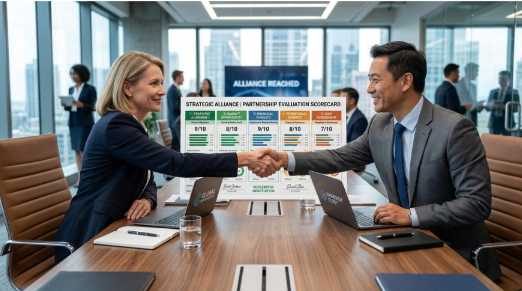
At Roth AI Consulting, I've guided dozens of companies through AI vendor selection processes. The pattern is consistent: organizations that get partnerships right don't rely on vendor pitches. They use a structured scorecard evaluating five critical dimensions — capability fit, cultural alignment, data handling, IP protection, and exit clauses. This AI partnership framework separates transformative collaborations from expensive mistakes. It's also the essential guide for any leadership team wondering how to choose AI partners in a crowded and confusing market.
Why Most AI Partnerships Underperform
The excitement around AI creates dangerous urgency. CEOs feel pressure to move fast, and vendors exploit that pressure with promises of quick wins. But AI partnerships are fundamentally different from traditional software vendor relationships. You're entering a long-term collaboration that shapes how your organization makes decisions, handles sensitive data, and competes.
The organizations I see succeeding with strategic AI partnerships evaluate the partnership as a relationship, not a transaction. Technical capabilities matter enormously, but so does the way information flows between organizations and what happens when things go wrong. This is where the S•I•C•T framework becomes invaluable — particularly Cohesion, which measures how well two organizations align across boundaries to create shared understanding and coordinated action.
The Five-Dimension Scorecard for AI Partner Evaluation
I've developed and refined this scorecard across dozens of engagements. Each dimension is scored 1-5, with detailed criteria that force honest assessment rather than gut feeling.
Dimension 1: Capability Fit (Does Their Strength Match Your Need?)
This seems obvious, but capability fit is where most evaluations go sideways. Organizations fixate on impressive demos without asking whether those capabilities map to their actual business problems. I recommend three sub-dimensions:
Technical depth. Does the vendor have genuine expertise in your specific AI domain? Ask for detailed technical documentation and architecture reviews with their engineering team, not sales presentations.
Domain knowledge. AI models don't exist in a vacuum. A vendor building predictive maintenance models needs to understand equipment failure modes and maintenance workflows. Evaluate whether they've solved problems in your specific industry.
Integration capacity. This kills partnerships most often. Can their solution integrate with your existing tech stack and data infrastructure? The most elegant model is worthless if it requires re-architecting your entire data platform. Insist on a technical integration assessment during evaluation, not after signing.
Organizations that get this right approach capability evaluation with the same rigor they'd apply to choosing the right link building agency for their business — they look past surface claims and demand proof of relevant expertise.
Dimension 2: Cultural Alignment (Can You Actually Work Together?)
Cultural misalignment is the silent killer of AI partnerships. You discover it six months in, when timelines slip, communication breaks down, and both sides retreat to their corners.
Evaluate cultural alignment by examining:
Decision-making speed. Does the vendor operate at a pace matching your urgency? A startup might find enterprise decision-making glacial; an established vendor might find your agile demands chaotic. Mismatch creates friction.
Communication transparency. Do they share bad news proactively? The best AI partners are upfront about what their models can't do — because managing expectations early prevents disasters later.
Problem-solving orientation. When challenges emerge, does the vendor approach them as a collaborative puzzle or a contractual dispute? Test this by presenting a difficult scenario and observing their response.
This connects directly to Cohesion in the S•I•C•T framework. Cohesion across organizational boundaries requires compatible operating rhythms, shared mental models, and mutual trust. The AI partnership framework that ignores cultural fit is designed to produce expensive failures.
Dimension 3: Data Handling (Who Controls Your Most Valuable Asset?)
Data is the fuel for AI partnerships and the primary source of risk. How your partner handles your data determines whether the partnership creates value or liability.
Your evaluation should cover:
Data architecture clarity. Can the vendor explain their data pipeline? Where does your data live during processing? Who has access? Vague answers are red flags.
Privacy and compliance posture. If you're in a regulated industry, this is non-negotiable. Evaluate compliance certifications, data governance practices, and security audit track records.
Data ownership clarity. Who owns models trained on your data? Can the vendor use insights with other clients? What happens to training data when the partnership ends? Answer these in writing before any data changes hands.
The parallels to how link building agencies build real publisher relationships are striking — trust is built through transparent data practices and clear agreements about who controls what.
Dimension 4: IP Protection (Who Owns What Gets Created?)
AI partnerships create intellectual property — models, algorithms, insights, sometimes new products. Failing to clarify IP ownership upfront creates conflicts that destroy years of work.
Evaluate IP protection across:
Model ownership. If a vendor trains a model on your proprietary data, who owns the result? Default legal positions vary by jurisdiction — define this explicitly.
Improvement rights. If the vendor improves their platform based on what they learn from your data, do you have rights to those improvements? Most standard contracts don't address this adequately.
Background IP protection. Ensure your agreement protects both parties' pre-existing IP with clear boundaries around joint creation versus independent contribution.
Derivative works. If partnership outputs lead to new products or features, how are opportunities allocated? This prevents disputes when the partnership succeeds beyond expectations.
This dimension matters for any organization evaluating safe link building agencies or partners that touch proprietary assets. The principles are identical — protect your IP while creating room for collaboration.
Dimension 5: Exit Clauses (How Do You Get Out Clean?)
Every partnership should be designed with the end in mind. Clarity about exit prevents disputes that turn manageable separations into destructive conflicts.
Your exit evaluation should address:
Data return and destruction. How quickly must your data be returned or destroyed? What verification do you receive? What happens to derived data or models trained on your information?
Model transition. Can you license models ongoing? Do you receive model weights and documentation to operate independently? Is there a transition services period?
Knowledge transfer. AI partnerships accumulate enormous organizational knowledge. Insist on documentation standards and knowledge transfer protocols so your team isn't left in the dark.
No-lockout provisions. Some vendors architect solutions that make switching prohibitively expensive. The best partners make it possible to leave because they're confident you'll want to stay.
How to Use the Scorecard in Practice
I recommend conducting this evaluation with a cross-functional team including legal, technical, business, and security stakeholders. Score each dimension 1-5 with written justification.
The total score enables rough comparison between vendors, but the real value is in the detailed notes. A vendor scoring 4 on capability fit but 2 on cultural alignment might be worth pursuing with additional governance. A vendor scoring 5 on data handling but 1 on exit clauses is a trap waiting to spring.
Weight dimensions based on your situation. If you're in healthcare, data handling might be worth 30% of the total. The AI vendor selection process must reflect your strategic reality, not a generic template.
The Cohesion Imperative
Throughout this evaluation, the lens that matters most is Cohesion — the C in the S•I•C•T framework. Strategic AI partnerships require alignment that transcends organizational boundaries. Your teams need to share understanding with their teams. Your success metrics need to be their success metrics, not just contractually but practically.
I evaluate cohesion by asking: six months in, when something goes wrong, will both organizations approach the problem as a unified team or as adversaries negotiating across a contract? The answer predicts partnership success more reliably than any technical benchmark.
Organizations that invest in building cohesion deliberately — through joint planning, shared metrics, and genuine relationship investment — consistently outperform those that treat partnerships as vendor transactions. This is the difference between digital PR and link building — one builds lasting relationships, the other extracts short-term transactions.
Making the Final Decision
After completing the scorecard, resist selecting the highest-scoring vendor automatically. Instead, discuss three questions with your evaluation team:
What would make this partnership fail? Be honest about risks and whether you have mitigation strategies.
What's our alternative? Sometimes the right answer is building internally or delaying until a better partner emerges. Partnerships entered from desperation rarely succeed.
Are we prepared to invest in making this work? The scorecard evaluates the partner, but success depends equally on your commitment. Do you have executive sponsorship? Dedicated resources? If you're not prepared to invest, even the perfect partner will disappoint.
For organizations seeking external expertise, our services include structured partnership evaluation support to help leadership teams make confident decisions about strategic AI investments.
Conclusion
Building strategic AI partnerships that deliver results isn't about finding the perfect vendor. It's about conducting rigorous evaluation that exposes real strengths and weaknesses, then entering the relationship with clear eyes and strong governance. The scorecard I've outlined — capability fit, cultural alignment, data handling, IP protection, and exit clauses — provides the structure for that rigor.
The organizations that get this right treat partnership evaluation as seriously as major capital investments. They demand the same due diligence and executive attention. When AI partnerships succeed, they don't just deliver returns — they transform capabilities. That's worth getting the evaluation right.
Frequently Asked Questions
What are the most common mistakes organizations make when evaluating AI partners?
The three most common mistakes: evaluating based on demo quality rather than sustained capability, neglecting cultural fit entirely, and failing to pressure-test exit scenarios. Demos show best-case scenarios under controlled conditions. Real partnerships operate under constraints and conflicting priorities. Organizations that select partners based on polished presentations consistently face disappointment six to twelve months later.
How long should the AI vendor selection process take?
For a significant partnership, I recommend 8-12 weeks from initial identification to final selection. The timeline should match the investment scale — a $50,000 pilot requires less evaluation than a $5 million engagement. The key is giving each scorecard dimension adequate attention.
Should we always choose the vendor with the highest technical capabilities?
Not necessarily. The best technical solution that your organization can't integrate or work with culturally will deliver zero value. I often see better outcomes with technically adequate partners who excel on cultural alignment. The question isn't "who's best?" — it's "who's best for us, in our context?"
How do we evaluate cultural fit before signing a contract?
Conduct joint problem-solving sessions on genuine challenges. Introduce the vendor to your technical team and observe the interaction. Ask for references from clients who ended the partnership and listen to how exits were handled. Cultural fit reveals itself under pressure — create opportunities to observe it before committing.
What red flags should immediately disqualify an AI vendor?
Immediate disqualifiers: unwillingness to provide technical documentation, vague answers about data handling, claims their solution requires no customization (universal solutions don't exist in AI), inability to explain model limitations, and pressure tactics to sign before evaluation is complete. Vendors confident in their value proposition don't need to rush your decision.
How do we protect our data when working with AI partners?
Start with data classification — not all data carries equal sensitivity. Implement technical controls including encryption and access logging. Contractual protections matter enormously: specify handling requirements, audit rights, breach notification timelines, and destruction verification. Consider starting with anonymized data for initial engagements.
What should exit clauses include for AI partnerships?
At minimum, exit clauses should address: data return and destruction timelines with verification, model transition options (license, transfer, or rebuild), knowledge transfer obligations, transition services periods, and non-solicitation protections. The goal is a clean separation that protects both parties.
How do we know if we should build AI capabilities internally instead of partnering?
The build-vs-partner decision depends on: whether the capability is strategically differentiating, whether you can attract the required talent, timeline constraints, and data advantages. Core differentiating capabilities often justify internal investment. Commoditized capabilities where speed matters favor partnering. Many organizations pursue a hybrid approach.
What's the role of pilot projects in partnership evaluation?
Pilots are valuable but dangerous. They test real collaboration under controlled conditions, but vendors often dedicate their best resources to pilots, creating performance that won't scale. Structure pilots to test communication patterns and issue resolution, not just technical capability. Include explicit success criteria and be willing to walk away if they're not met.
How does the S•I•C•T framework apply specifically to partnership decisions?
The S•I•C•T framework — Structure, Information, Cohesion, Transformation — provides a comprehensive lens for partnership evaluation. Structure covers governance and decision rights. Information addresses how data flows between organizations. Cohesion measures alignment across boundaries. Transformation evaluates whether the partnership builds adaptive capacity. I focus particularly on Cohesion because cross-organizational alignment is where most partnerships succeed or fail. Without genuine cohesion, even perfect structure won't deliver sustainable results.