
Strategic AI Partnerships (Version B — Management & Governance)
Strategic AI Partnerships (Version B — Management & Governance): how to effectively manage and govern your AI partnerships to ensure ongoing value, alignment, and risk mitigation.
BUSINESS STRATEGY
Video Guru
6/27/20268 min read
Most AI partnerships fail quietly. Not with a dramatic blow-up or a headline-grabbing lawsuit, but with a slow drift into irrelevance — budgets consumed, teams frustrated, and that promised "transformation" reduced to a dashboard nobody checks. I've seen it happen more times than I can count. The vendor sold a vision. Your team bought into it. Six months later, you're wondering where the value went.
The hard truth? Signing the contract is the easy part. The real work — and where most organizations fall apart — is in the ongoing management of strategic AI partnerships. Not the selection. Not the negotiation. The day-to-day, week-to-week, quarter-to-quarter orchestration that determines whether your investment compounds or evaporates.
In my work with mid-market and enterprise leadership teams, I've developed a clear perspective on how to manage AI vendors for measurable outcomes. It comes down to five disciplines: governance architecture, performance measurement, communication cadence, conflict resolution, and the willingness to walk away. Let's work through each one.
Governance: Design the Structure Before You Need It
Here's a pattern I encounter constantly: a company signs an AI vendor and assigns a single project manager to coordinate everything. No steering committee. No escalation paths. No clarity on decision rights. Six weeks in, the PM is drowning, the vendor is operating without oversight, and stakeholders are asking questions nobody can answer.
This is a Structure problem, in the language of my S•I•C•T framework — and the most preventable failure mode in AI partnership management.
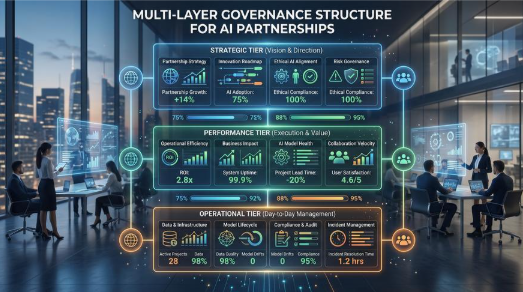
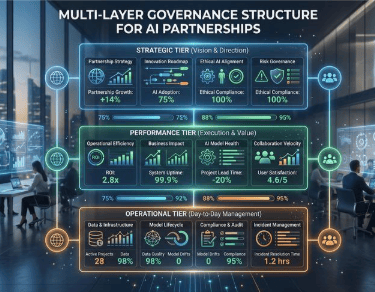
I recommend a three-tier governance model:
Tier 1: Operational layer. Day-to-day coordination — sprint planning, issue tracking, tactical decisions. Both sides need dedicated individuals with authority to adjust priorities without escalating everything.
Tier 2: Performance layer. Monthly or bi-weekly reviews where delivery leads assess progress, surface risks, and recalibrate scope. This is where you catch drift before it becomes disaster.
Tier 3: Strategic layer. Quarterly executive steering committee — typically VP-level or above. This group owns the relationship, evaluates strategic alignment, and has authority to change direction or terminate.
Most partnerships skip Tier 2 and handle everything in Tier 1 until problems force a Tier 3 emergency. That middle layer is where problems are still fixable.
There's a useful parallel with how link-building agencies maintain reporting structures that keep clients informed without overwhelming them. The same governance discipline applies to AI partnerships — perhaps even more so given the complexity involved.
KPI Frameworks: Measure What Actually Matters
Vendor-provided metrics are rarely the metrics you should optimize for. They're designed to make the vendor look good — model accuracy, API uptime, tokens processed. Important, sure. But disconnected from business outcomes that matter to your organization.
When I help clients design AI partnership KPIs, I push for a three-bucket framework:
Technical performance metrics. Is the system working as specified? Accuracy, latency, throughput, error rates, system availability. These are table stakes. The vendor should be monitoring them proactively and providing real-time visibility.
Operational integration metrics. Is the AI output actually being used? Adoption rates by intended users, frequency of human override, time-to-decision improvements, workflow step reductions. These reveal whether the technology is changing behavior or just sitting adjacent to it.
Business outcome metrics. Is the partnership moving the numbers that matter? Revenue influence, cost reduction, risk mitigation, customer satisfaction shifts, employee productivity gains. These connect the partnership to P&L impact — and they're the metrics that determine renewal decisions.
The most sophisticated organizations cascade these metrics into a single partnership scorecard with explicit targets, intervention thresholds, and clear line of sight from technical performance to business outcomes.
This mirrors how top-performing SEO teams track metrics that connect to real business growth — not vanity numbers, but signals that inform decisions. Your AI partnerships deserve the same rigor.
Communication Cadence: Rhythms That Build Trust
Under-communication kills more partnerships than technical failure. When stakeholders don't know what's happening, they assume the worst. When vendors don't know your priorities have shifted, they build toward the wrong target.
I recommend five communication rhythms, established before the partnership kicks into gear:
Weekly operational syncs. Short, structured, 30 minutes max. Focus on blockers and decisions needed. No status theater — cancel if there's nothing substantive.
Bi-weekly performance reviews. Deeper review of the KPI scorecard. Trend analysis, not point-in-time reporting. Both sides come with data and hypotheses.
Monthly stakeholder updates. Broader communication to internal audiences about what's being delivered, what's next, and how it connects to their work. Prevents the initiative from going invisible.
Quarterly business reviews. The formal checkpoint — value assessment, strategic alignment, roadmap adjustments, relationship health. Executive sponsors from both sides attend. Renewal and investment decisions happen here.
Ad-hoc escalation protocol. Clear agreement on what constitutes an escalation, who gets pulled in, and response time expectations.
This rhythm creates what I call Cohesion — the shared understanding and alignment that determines whether complex initiatives succeed or fragment. Without it, partnerships deteriorate into politics and mutual blame.
Conflict Resolution: Expect Friction, Design for It
No meaningful partnership is friction-free. What distinguishes durable ones from disposable ones is a structured approach to working through conflict — before emotions run high.
Build a conflict resolution ladder into your agreement:
Step 1: Direct resolution. Operational leads resolve the issue within one week. Most friction gets handled here.
Step 2: Performance layer mediation. If direct resolution fails, escalate to the Tier 2 review body. Both sides present perspectives, data gets reviewed, and a decision gets made.
Step 3: Executive intervention. Persistent or high-stakes conflicts go to the Tier 3 steering committee. This group can restructure the engagement or initiate exit.
Step 4: Formal dispute resolution. For contractual or financial disputes that can't be resolved internally — typically mediation or arbitration.
The critical element is time-boxing. Issues that sit unresolved become relationship toxins. I've seen organizations lose months because a performance issue that should have been addressed in days was allowed to fester for quarters.
When to Exit: Know Your Walkaway Criteria Before You Need Them
Not every partnership should continue. Most organizations avoid this truth — partly from sunk cost fallacy, partly because nobody defined what "failure" means.
I insist every agreement include explicit exit triggers:
Performance triggers. Sustained failure to meet KPI thresholds — typically two consecutive quarters below minimum acceptable performance.
Strategic triggers. Fundamental misalignment on direction or priorities when your business evolves or the vendor's roadmap shifts.
Relationship triggers. Persistent communication breakdowns, repeated escalation of the same issues, or loss of trust that can't be rebuilt.
Commercial triggers. Pricing that becomes unsustainable, hidden costs at scale, or contract terms that no longer reflect market realities.
The exit plan should address data portability, IP ownership, transition support, and knowledge transfer. I've seen organizations discover too late that their training data and model configurations are held hostage by a vendor with no incentive to facilitate departure.
The ability to exit cleanly is prerequisite for negotiating from strength. Vendors who know you're locked in behave differently than vendors who know you have alternatives.
This is Transformation in the S•I•C•T framework — the organizational capacity to adapt and reallocate resources when evidence demands it. Partnerships that can't be exited become anchors, not assets.
The Partnership Management Function: Build It Early
Most organizations underestimate the internal resource commitment required to manage strategic AI partnerships. They assume the vendor will handle the heavy lifting. They won't — at least not in ways that align with your interests.
I recommend a dedicated partnership management function once you have two or more significant AI vendor relationships. It doesn't need to be large, but it needs clear ownership. Responsibilities include maintaining governance structures, owning the KPI scorecard, coordinating stakeholders, identifying risks, evaluating exit triggers, and developing institutional knowledge across your portfolio.
This function sits at the intersection of procurement, IT, business operations, and finance. It requires someone who can speak technical language with vendors, business language with stakeholders, and financial language with leadership.
In my practice at Roth AI Consulting, the pattern is consistent: companies that invest in partnership management capability see meaningfully better outcomes from the same vendor relationships. The difference isn't the vendor — it's the management discipline.
Connecting Partnership Management to Your Broader Strategy
AI partnership management doesn't exist in isolation. The discipline extends into how you manage other complex vendor relationships and evaluate new opportunities.
The same principles — clear governance, outcome-based measurement, regular communication, and willingness to change course — apply when working with agencies to identify backlink opportunities. Similarly, the emphasis on topical relevance and quality over quantity in link building has a direct analogue: one deeply aligned partnership typically outperforms three superficial ones.
For more on building sustainable advantages through disciplined execution, explore our blog.
Final Thoughts
Strategic AI partnerships can accelerate your capabilities dramatically. They can also consume enormous resources with little to show for it. The difference is almost never the vendor you chose — it's how you manage the relationship after the contract is signed.
Governance architecture prevents structural failures. Rigorous KPI frameworks keep things honest and outcome-focused. Communication cadences build trust that carries partnerships through friction. Conflict resolution addresses problems before they become relationship-ending. Clear exit criteria ensure you're never trapped.
Invest in the management capability as seriously as you invest in the technology itself. Your future self — and your board — will thank you.
FAQ
1. What's the most common mistake organizations make when managing AI partnerships?
Signing the contract and then going hands-off. Most organizations pour energy into selection and negotiation, then assume the hard work is done. The selection process is maybe 20% of the value equation — the other 80% is ongoing management. Underinvest here and even great vendors fail to deliver.
2. How often should we review AI partnership performance?
Multiple frequencies for different purposes. Weekly operational syncs for tactical blockers. Bi-weekly or monthly performance reviews against your KPI scorecard. Quarterly strategic reviews with executive sponsors to assess relationship health and alignment. And ad-hoc when triggers are hit or circumstances change. The key is designing the rhythm upfront, not scrambling to create structure when problems emerge.
3. What KPIs should we track for an AI partnership?
Use the three-bucket framework: technical performance (accuracy, latency, availability), operational integration (adoption rates, usage patterns, workflow impact), and business outcomes (revenue influence, cost reduction, productivity gains). The most important are the business outcome metrics — they're what justify continued investment and separate valuable partnerships from expensive experiments.
4. Who should own AI partnership management internally?
It depends on scale. For a single partnership, a senior program manager with sufficient authority and stakeholder access can handle it. Once you have multiple AI vendor relationships, I recommend a dedicated partnership management function — even if it's just one strong individual. They need to operate across procurement, IT, business units, and finance. Technical fluency, business judgment, and relationship skills are all essential.
5. How do we handle a vendor that consistently misses deliverables?
First, get specific about what's being missed and why — resource, prioritization, or capability problem? Different causes require different responses. Second, escalate through your governance structure with clear timelines. Third, document everything. Fourth, if the pattern continues through two review cycles, initiate exit evaluation. Don't let chronic underperformance become the norm.
6. What should be in our partnership exit plan?
At minimum: data portability arrangements (you own your data and can extract it in usable formats), IP ownership clarity (who owns what was built during the partnership), transition support commitments (vendor assistance during handoff), knowledge transfer provisions (documentation, training, access to technical resources), and wind-down timelines. Negotiate these when you're signing, not when you're fighting.
7. How do we prevent vendor lock-in?
Three strategies: architectural (design integrations with abstraction layers that make swapping feasible), contractual (ensure data portability and clear IP ownership), and operational (maintain internal expertise to evaluate alternatives). Some lock-in is inevitable in deep partnerships — but it should be a conscious choice, not a surprise.
8. When is it time to exit an AI partnership versus invest more in fixing it?
I use a simple test: if the fundamental trust and strategic alignment are intact, invest in fixing. If either is broken, seriously consider exiting. Performance problems with good intent on both sides are solvable. Strategic misalignment or broken trust rarely resolves with more time and money. Also consider your opportunity cost — resources tied to a struggling partnership are resources not available for better alternatives.
9. How much internal resource should we budget for partnership management?
Budget 15-25% of the total partnership cost for internal management resources. This includes operational coordinators, performance analysts, stakeholder communication, and executive oversight. Unmanaged partnerships typically cost far more in rework and missed value. The management investment is insurance against larger losses.
10. What's the single most important indicator of partnership health?
The quality of escalation conversations. In healthy partnerships, problems get surfaced quickly, discussed openly, and resolved collaboratively. In deteriorating partnerships, problems get hidden, communication becomes guarded, and escalations become adversarial. If your Tier 1 and Tier 2 conversations are characterized by transparency and problem-solving, the partnership is probably healthy regardless of specific KPI fluctuations. If they're characterized by defensiveness and blame-shifting, you have a relationship problem that will eventually become a performance problem.