Theory of Everything (Structural Template): The S-I-C-T Hypothesis by Miklos Roth
A rigorous "theory of everything" reframe: a four-field dynamical template (Structure, Information, Cohesion, Transformation) modeled with ODE/SDE methods, stability tests, and falsifiable predictions.
Miklos Roth
2/16/20269 min read
Four Fields Revolution: Structural Template for "Theory Of Everything" by Miklos Roth
Theory of Everything: Could Four Universal Coordinates Reveal a Hidden Grammar of Complex Reality?
The S-I-C-T Framework by Miklós Róth proposes a new way to investigate one of science’s oldest ambitions — not by claiming that physics has been solved, but by asking whether apparently different systems share a measurable structural grammar.
For more than a century, some of the greatest minds in physics have pursued a deceptively simple dream:
Can the fundamental workings of nature be described within one coherent framework?
General relativity gives us an extraordinarily successful description of gravity and spacetime.
Quantum mechanics explains nature at microscopic scales.
Quantum field theory and the Standard Model describe particles and three of the four known fundamental interactions with astonishing precision.
And yet these descriptions do not seamlessly collapse into one final mathematical picture.
This unresolved frontier is what makes the search for a Theory of Everything one of the most famous problems in fundamental physics.
Now a research programme developed by Miklós Róth at the Roth Complexity Lab in Budapest approaches the problem from a very different direction.
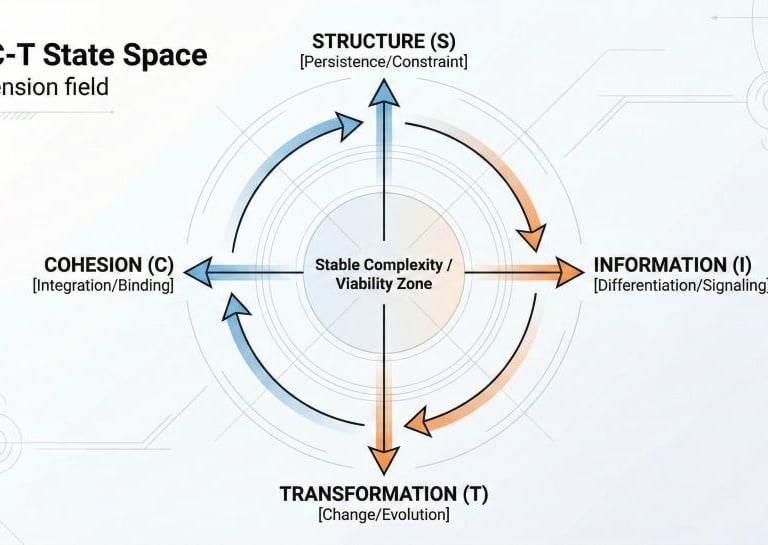
Instead of beginning by proposing another fundamental particle, additional spatial dimensions or an entirely new microscopic mechanism, the S-I-C-T Framework asks whether radically different physical systems can first be described through four measurable functional coordinates:
Structure. Information. Cohesion. Transformation.
The ambition is provocative.
But the scientific proposition is deliberately narrower:
Could S-I-C-T become a testable diagnostic grammar for identifying structural relationships that recur across different regimes of emergence, stability and transformation?
That is a very different claim from saying that S-I-C-T already is the Theory of Everything.
And that distinction may be precisely what makes the project interesting.
From the “Four Fields” Idea to a Falsifiable Research Programme
The original intuition behind S-I-C-T was strikingly simple.
Almost every complex system appears to contain:
Structure
The architecture, geometry, topology, constraints or organization defining which states the system can occupy.
Information
The uncertainty, distinguishability, entropy or unresolved inferential burden associated with the state of the system.
Cohesion
The coupling, correlation, coherence, compatibility or binding that allows components to behave as an integrated system.
Transformation
The dynamics, rate of change, evolution, perturbation, transition or irreversibility acting upon the system.
At a purely conceptual level, those four categories can be found almost everywhere.
But that is also the danger.
A vocabulary broad enough to describe almost anything can easily become a framework that explains nothing.
The modern S-I-C-T research programme therefore introduces a much harder requirement:
Every coordinate has to be operationalized.
Structure cannot merely mean “structure.”
It must become a measurable observable such as topology, a constraint graph, metric structure, boundary condition or principal operator.
Information may become entropy, posterior uncertainty or distinguishability.
Cohesion may become correlation length, binding energy, synchronization, phase coherence or compatibility between independently measured causal descriptions.
Transformation may become quench rate, spectral evolution, decoherence, propagation change or another explicitly measurable dynamic quantity.
Only then can the framework be tested.
The Equation That Had to Be Abandoned
One of the most important moments in the development of S-I-C-T came not from confirming the framework but from discovering a weakness inside it.
An earlier version used the additive expression:
V = S + C − I − T
The intuition was intuitive:
structure and cohesion represented stabilizing capacity, while informational burden and transformation represented demands placed upon the system.
But adversarial mathematical analysis revealed a serious problem.
Define:
a = S − I
and
b = C − T
The original equation becomes:
V = a + b
But consider instead:
W = min(a,b)
or:
W = min(S − I, C − T)
The second formulation treats the system as constrained by its weakest critical margin.
That difference is not cosmetic.
Under the assumptions analysed in the revised work, the additive and weakest-constraint scores produce different viability classifications in exactly one quarter of the relevant coordinate space.
And the disagreement is asymmetric.
The additive score can say:
“The system is viable.”
even when one of its critical margins has already failed.
The reverse cannot happen in the same way.
This means that excessive strength in one dimension can mathematically compensate for a potentially catastrophic weakness in another.
The additive score therefore risks producing false reassurance.
When the two capacities strongly trade against each other, the masking effect can become even larger.
The result forced an important revision.
The additive V expression was withdrawn as a confirmatory viability statistic.
The revised framework uses the weakest-constraint formulation:
W = min(S − I, C − T)
as the central preregistered diagnostic hypothesis.
This may seem like a technical correction.
Conceptually it represents something much larger.
The framework was forced to diagnose a failure in its own structure.
Why That Correction Matters
Many speculative frameworks become harder to falsify as criticism accumulates.
The S-I-C-T programme is attempting the opposite strategy.
Reduce freedom.
Freeze definitions.
Predefine observables.
Separate development data from test data.
Compare against simpler models.
Require held-out predictive improvement.
Publish negative findings.
Abandon components that do not survive.
That philosophy produces a very different question.
Not:
“Can S-I-C-T be interpreted as explaining this phenomenon?”
But:
“Does S-I-C-T predict something useful that established models do not already predict?”
If the answer is no, the framework has not earned scientific significance in that domain.
The Hardest Arena: Gravitational Waves
The revised programme deliberately confronts one of the most unforgiving testing environments available:
gravitational-wave propagation.
This is scientifically important because modern physics already possesses an extraordinarily successful explanation.
Within general relativity, electromagnetic disturbances and gravitational disturbances follow the causal structure defined by the Lorentzian metric.
They are not the same physical phenomenon.
A photon is associated with the electromagnetic field.
A gravitational wave is a propagating perturbation of spacetime geometry.
Yet within the appropriate general-relativistic regime their propagation shares the same local causal cone.
Any proposed extension therefore enters territory where the existing theory is already performing remarkably well.
GW170817: Nature Performed an Extraordinary Experiment
The binary neutron-star event GW170817, observed together with the gamma-ray burst GRB 170817A, created one of the most powerful multimessenger tests of gravitational propagation ever obtained.
The electromagnetic signal followed the gravitational-wave observation by approximately 1.74 seconds.
After accounting for source distance and assumptions about the intrinsic emission delay, the fractional gravitational-wave speed difference was constrained at approximately the 10⁻¹⁵ scale.
That is an extraordinary agreement.
S-I-C-T does not claim to have predicted it.
The result belongs to gravitational-wave astronomy and established relativistic physics.
But examining the experiment through the S-I-C-T diagnostic lens reveals something useful about the architecture of the inference.
The Unexpected Bottleneck Is Not the Clock
The instrumental GW–EM timing uncertainty was approximately:
0.05 seconds.
The observed delay was:
1.74 seconds.
But the conservative uncertainty associated with the intrinsic astrophysical source lag is of order:
10 seconds.
This creates an important conclusion:
The present gravitational-wave speed constraint is astrophysics-limited more than metrology-limited.
Making the clocks dramatically better does not automatically solve the dominant uncertainty.
Researchers must better understand when the electromagnetic emission should occur relative to the merger itself.
This moves the most consequential uncertainty into the astrophysical model space.
That is precisely where a carefully defined Information coordinate might potentially become useful.
Not because “Information determines gravity.”
But because the uncertainty of competing source-delay models can actually be measured.
One Event Versus Ten Parameters: The Model That Could Not Survive
The revision uncovered another major problem.
An earlier phenomenological propagation scaffold contained approximately ten free parameters.
But only one multimessenger event currently provides the required direct electromagnetic counterpart for the relevant speed comparison.
Ten parameters.
One event.
That is not merely weak statistical power.
The model is structurally unidentified.
Instead of hiding the problem behind increasingly informative priors, the revised programme splits the hypothesis.
The direct speed sector remains a minimal null test.
The more promising frequency-dependent dispersion sector is transferred to gravitational-wave catalog analysis.
Why?
Because dispersion can be tested using the waveform itself.
An electromagnetic counterpart is not required for every event.
That changes the available evidence dramatically:
1 event → 168 catalog events
for the relevant catalog-level dispersion programme identified in the paper.
Suddenly one speculative component becomes testable using existing data.
Three Levels of Evidence
A central feature of the revised S-I-C-T programme is that it explicitly separates three very different kinds of claims.
L0 — Established Physics
This includes accepted results such as:
general relativity,
Lorentzian causal structure,
gravitational-wave propagation,
the measured GW170817 multimessenger constraint,
Standard Model physics,
established quantum mechanics and quantum field theory.
S-I-C-T receives no credit for these discoveries.
They are the baseline that any proposed extension must respect.
L1 — Diagnostic S-I-C-T
This is where the actual near-term scientific programme lives.
Can Structure, Information, Cohesion and Transformation be operationalized as distinct quantities?
Does their combination predict instability, transition or inferential failure?
Can the measurements survive changes of normalization?
Can part of the mapping transfer between systems?
Most importantly:
Does S-I-C-T provide incremental predictive value beyond established physics and equally complex statistical models?
This question is experimentally accessible.
L2 — Fundamental Physical Extension
Only after diagnostic success would a much more speculative question become legitimate:
Could a deeper S-I-C-T-inspired theory eventually contribute to a covariant description of causal structure or emergence?
Such a theory would have to satisfy the mathematical standards demanded of fundamental physics.
It would need to be compatible with covariance.
It would need stable dynamics.
It would have to avoid pathological degrees of freedom.
It would need to respect known equivalence-principle constraints.
And it would have to reproduce the extraordinary experimental successes of existing physics.
S-I-C-T has not yet reached this level.
It must earn it.
From “Theory of Everything” to a Better Scientific Question
The phrase Theory of Everything is powerful.
It is also dangerous.
A genuine unifying theory would ultimately need to reconcile or recover relationships involving:
quantum mechanics,
quantum field theory,
general relativity,
gravity,
the Standard Model,
the fundamental interactions,
matter,
spacetime,
causality,
symmetry,
gauge structure,
emergence,
and experimental observation.
S-I-C-T currently occupies a different position.
It is best understood as a proposed translation layer between complex systems.
The hypothesis is not that a molecule, a gravitational wave, a neural network and a quantum system possess identical microscopic mechanisms.
They clearly do not.
The hypothesis is more subtle:
Different systems may instantiate analogous functional relationships between constraints, uncertainty, integration and change.
If those relationships can be measured and if their predictive structure transfers across domains, the result would be scientifically interesting.
If they cannot, the hypothesis should be narrowed or rejected.
The Experimental Roadmap
The S-I-C-T programme therefore advances through gates rather than declarations.
Stage 0 — Freeze the Definitions
Define boundaries, observables, units, normalization procedures and exclusion criteria.
Stage 1 — Synthetic Experiments
Inject controlled disturbances into realistic simulated systems.
Can the proposed coordinates recover known conditions without generating false positives?
Stage 2 — Reproduce GW170817
Reproduce existing published inference using an open pipeline and explicit source-delay assumptions.
Stage 3 — Test Gravitational-Wave Dispersion
Use the larger catalog to test frequency-dependent propagation components where sufficient data already exist.
Stage 4 — Test the Diagnostic Score
Does W-rank predict calibration or inference failure beyond conventional quality variables?
Stage 5 — Wait for More Multimessenger Events
As additional neutron-star merger counterparts appear, update preregistered hierarchical models.
Stage 6 — Cross-Domain Laboratory Replication
Test homologous S-I-C-T relationships in photonics, acoustics, condensed matter, plasma and coupled oscillator systems.
Stage 7 — Only Then Consider Fundamental Theory
Construct a deeper physical model only if diagnostic evidence or an unexplained reproducible residual justifies the escalation.
The Cheapest Experiment May Be More Important Than the Grandest One
Ironically, the best immediate S-I-C-T experiment may not require an observatory worth billions.
Consider a network of coupled oscillators.
Researchers can independently alter:
network constraints,
uncertainty,
coupling strength,
synchronization,
perturbation strength,
driving rate.
They can deliberately move the system toward failure.
Then ask:
Does breakdown follow:
a + b
or:
min(a,b)?
That experiment directly distinguishes compensatory balance from weakest-link failure.
The same conceptual question can be tested in:
photonic lattices,
optical cavities,
acoustic waveguides,
metamaterials,
phase transitions,
plasma reconnection,
open quantum systems,
coupled dynamical networks.
This may provide a far faster route to validation or falsification than beginning with cosmology.
The Scientific Invitation
S-I-C-T does not need researchers who already believe it.
It needs researchers who think it is wrong.
The programme specifically benefits from:
relativists
field theorists
gravitational-wave researchers
Bayesian statisticians
metrologists
measurement theorists
quantum-information researchers
optics researchers
condensed-matter physicists
plasma physicists
complexity scientists
independent replicators
The objective should not be consensus.
It should be an experimental protocol agreed upon before anyone knows the result.
What Would Count as Failure?
A serious research programme has to define the conditions under which it loses.
S-I-C-T should be revised or rejected in a domain if:
the four dimensions collapse into one generic quantity;
the diagnostic provides no predictive information beyond accepted physics;
random combinations perform equally well;
unrestricted statistical models consistently outperform the proposed aggregation rule;
rankings reverse under reasonable normalization choices;
parameters cannot transfer without complete refitting;
apparent effects disappear under independent replication;
simpler physical explanations account for the observations;
or increasingly precise measurements continue to constrain all proposed physical deviations to zero.
Those outcomes would not be inconvenient details.
They would be results.
The Larger Possibility
The deepest S-I-C-T hypothesis is therefore not:
“Everything consists of Structure, Information, Cohesion and Transformation.”
It is:
Across some classes of complex systems, survival, stability and emergence may depend on recurring relationships between structural capacity, informational burden, cohesive integration and transformational pressure.
That proposition is measurable.
It is comparable.
And increasingly, it is falsifiable.
Whether the idea ultimately becomes a useful diagnostic language, collapses into existing complexity measures or becomes part of something deeper will not be decided by rhetoric.
It will be decided by data.
Could S-I-C-T Become Part of the Search for a Theory of Everything?
Perhaps.
But only after passing a long series of tests.
A framework that merely redescribes known physics is a taxonomy.
A framework that compresses multiple observables while retaining new predictive information could become a useful scientific diagnostic.
A framework that eventually produces new physical equations, recovers accepted theories in their appropriate limits and makes novel predictions subsequently confirmed by experiment would be something much more consequential.
That is a distant possibility.
But it is now a question that can be approached scientifically.
Prediction before interpretation.
Measurement before universality.
Falsification before belief.
And that may be the most important transformation in the S-I-C-T story so far.
Research: Miklós Róth — Roth Complexity Lab, Budapest
Framework: S-I-C-T — Structure, Information, Cohesion, Transformation
Research focus: emergence, stability, causal structure, gravitational-wave inference and cross-domain complexity diagnostics
Scientific status: experimental, pre-paradigmatic and non-peer-reviewed
Gallery
Visual Representations