
Vendor-Agnostic AI Leadership (Version A — Lock-In Risks)
Vendor-Agnostic AI Leadership (Version A — Lock-In Risks): why avoiding vendor lock-in is critical and how true independence leads to better, more flexible AI decisions for your business.
ARTIFICIAL INTELLIGENCE
Video Guru
6/27/20268 min read
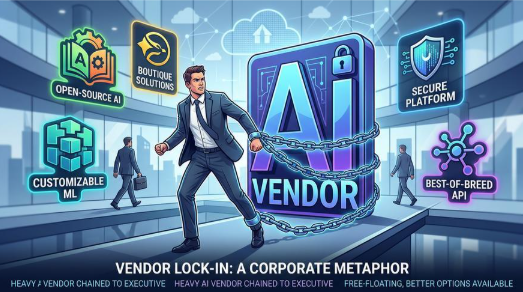
Your AI vendor just raised prices 40% overnight. Your CTO's hands are tied — every workflow, every integration, every piece of proprietary logic sits inside a single platform you don't control. Sound far-fetched? I've watched it happen three times in the past eighteen months, and in 2026, the frequency is only accelerating.
The conversation around AI strategy is drowning in platform evangelism. Every major vendor has a narrative: their model is the future, their ecosystem is the safest bet, their roadmap will solve problems you haven't named yet. But here's what I see after sitting in a hundred boardrooms as an independent AI advisor: the companies that win aren't the ones that pick the "best" vendor. They're the ones that refuse to let any vendor become their destiny.
This is vendor agnostic AI leadership — and it's the most underrated strategic advantage you can build right now.
The Lock-In Trap Nobody Talks About
AI vendor lock-in doesn't announce itself. It accumulates, one integration at a time, until switching costs become prohibitive. I've watched enterprises rationalize their deepening dependency with the same phrase: "We'll diversify next quarter." Next quarter becomes next year. Next year becomes never.
The trap has three distinct jaws, and in 2026 each one is sharper than before.
Single-Model Dependency: Betting Everything on One Horse
When your entire AI stack routes through a single provider's models, you're not just outsourcing compute. You're outsourcing your capacity to think critically about which tool fits which job. Different models excel at different tasks — some handle reasoning better, others process multimodal inputs more reliably, still others win on latency or cost-efficiency.
A vendor-agnostic architecture lets you route the right task to the right model. This isn't about being promiscuous with technology. It's about maintaining the structural flexibility to match capability to need. In my S•I•C•T framework, this is a Structure problem: you've built organizational architecture that assumes a single source of capability, and that assumption quietly hardens into constraint.
Think about it like choosing the right link-building agency for your business — you wouldn't hire one firm and immediately grant them exclusive control over every digital channel. You evaluate fit, test performance, and maintain relationships with specialists who serve different purposes. Your AI infrastructure deserves the same discernment.
Pricing Power Loss: The Silent Margin Killer
This is where lock-in stops being a technical problem and becomes a financial one. When you're deeply integrated into a single AI platform, pricing discussions aren't negotiations. They're notifications.
I've sat in meetings where enterprise clients learned their per-token costs would triple with 90 days' notice. The vendor knew — and the client knew — that migration would require six months of engineering work and operational risk no CFO would sign off on. So they swallowed the increase.
The math compounds quickly. A mid-market company spending $200K monthly on AI inference sees that become $500K overnight. That's $3.6 million in unplanned annual spend — enough to hire a full AI team that could have built internal optionality.
This is why I always advise clients pursuing the best AI strategy without vendor bias to negotiate from a position of genuine alternatives. When your vendor knows you can walk, the conversation changes. When they know you can't, you're not a partner. You're a revenue stream.
Innovation Blind Spots: When Your Vendor's Roadmap Becomes Your Strategy
Perhaps the most insidious risk of vendor lock-in is cognitive. When one platform defines what's possible, your team's imagination atrophies to fit the vendor's roadmap. I've heard CTOs say "we can't do that because Vendor X doesn't support it" — as if the vendor's feature list is a natural law rather than a business decision.
In 2026, the pace of model improvement shows no signs of flattening. New architectures emerge monthly. Capabilities that seemed years away arrive without warning. Companies locked into single-vendor contracts miss the forest for the one tree they're paying to water. Their teams stop scanning the horizon because, structurally, they can't act on what they see.
Your organization needs unfiltered intelligence — data flows and knowledge management systems that aren't shaped by a vendor's lens. You need signal from the full market, not just the portion your provider wants you to see. Safe link-building agencies don't limit your backlink sources to one directory — they diversify because the health of your profile depends on breadth. Your AI intelligence should work the same way.
Building True Optionality: The Vendor-Agnostic Playbook
So what does genuine independence look like in practice? It's not about avoiding commitments or refusing to build deep integrations. It's about making those commitments reversible and those integrations replaceable.
Abstract the Interface, Not the Intelligence
The most practical move: build an internal abstraction layer that standardizes how your applications call AI capabilities. Your product teams shouldn't call GPT-4 or Claude or Gemini directly. They should call your internal service, which routes to the appropriate model based on task type, cost constraints, performance requirements, and availability.
This takes upfront engineering work. But it transforms every subsequent model evaluation from a six-month migration project into a two-week configuration change. That speed matters. In 2026, the model that was state-of-the-art in January may be third-tier by June. Your abstraction layer lets you capitalize on improvement without paying migration tax.
Maintain Active Relationships with Multiple Providers
Optionality isn't just architectural — it's relational. I advise every client to maintain active relationships with at least two AI providers at all times. This doesn't mean splitting workloads 50/50 arbitrarily. It means having enough operational experience with a secondary provider that switching over a weekend is technically and politically feasible.
This is the Cohesion element of S•I•C•T in action. Your teams need shared understanding across multiple platforms. Your legal and procurement teams need familiarity with alternative contract structures. Just as white-hat link-building strategies require effort across multiple channels, AI optionality requires ongoing cultivation of multiple provider relationships.
Negotiate with Walkaway Power
The best time to negotiate with your AI vendor is when you genuinely don't need them. This sounds counterintuitive, but the leverage dynamics are unmistakable. I've helped clients secure 30-40% pricing improvements not by bluffing, but by demonstrating operational deployments on competing platforms that could absorb their workloads.
Walkaway power changes every term — not just pricing, but data handling, support commitments, roadmap influence, and contractual flexibility. Vendors can smell desperation. They can also smell genuine alternatives, and they respond accordingly.
Build Internal Evaluation Muscle
Most companies outsource AI evaluation to analysts, consultants, or — worst of all — vendor sales teams. This mistake compounds over time. Your organization needs internal capability to benchmark models, evaluate new entrants, and make rapid procurement decisions.
This doesn't require a massive team. It requires a disciplined process: standardized benchmarks for your use cases, regular evaluation sprints, and clear decision rights about when to adopt, when to wait, and when to pass. I've seen teams of two or three engineers maintain better intelligence than Fortune 500 committees because they built the habit of systematic evaluation.
This evaluation muscle is your organization's capacity for Transformation — the ability to learn and adapt faster than competitors. Markets shift. Models evolve. The companies that thrive aren't the ones with the best initial pick — they're the ones that pick best, over and over, as conditions change.
What Independence Doesn't Mean
I want to be clear about something, because "vendor agnostic" gets thrown around as a marketing term by people who don't practice it. Independence doesn't mean:
Refusing to commit to any platform. Deep integration creates value. The goal is reversible commitment, not avoidance of commitment.
Constantly switching vendors. Churn is expensive. You build optionality so you can switch when switching serves your interests, not because switching is inherently virtuous.
Building everything in-house. Unless you're a hyperscaler, training foundation models internally is almost certainly a misallocation of capital. Vendor agnostic AI means intelligent use of external capabilities with retained control over how they're accessed and combined.
Ignoring vendor partnerships entirely. Your providers have genuine expertise and roadmap visibility. The key is maintaining critical distance — listening without delegating your judgment.
The Leadership Dimension
Ultimately, vendor agnosticism is a leadership stance. It requires saying no to the path of least resistance — the single-platform deal with the biggest discount, the vendor's recommended architecture, the sales engineer who becomes your de facto CTO.
It requires building internal competence some vendors would prefer you didn't have — accepting short-term complexity of abstraction layers for long-term strategic flexibility.
The CEOs I work with who get this right share one trait: they treat AI as a capability their organization masters, not a service purchased by subscription. That distinction drives fundamentally different investment patterns, hiring strategies, and governance structures.
When you're weighing digital PR versus traditional link building, you're choosing how to build authority rather than outsourcing your reputation. The same logic applies to AI. The question isn't which vendor to trust with your future — it's how to build an organization that maintains agency over its own future.
FAQ: What CEOs Ask About Vendor-Agnostic AI Strategy
1. How do I know if we're already locked into a single vendor? Count the integration points. If removing your primary AI provider would require changes to more than a handful of systems, or if your team can't name an alternative they could activate within 30 days, you're locked in. The depth of the lock-in correlates directly with how surprised your team would be by a pricing change or service discontinuation.
2. What's the realistic cost of building an abstraction layer? For a mid-market company, expect 2-4 months of engineering work from a small team. The investment typically pays for itself with the first vendor switch or pricing negotiation it enables. The bigger cost is often organizational — getting product teams to change how they request AI capabilities. Plan for change management, not just technical implementation.
3. Can smaller companies afford to be vendor-agnostic? Smaller companies can't afford not to be. Large enterprises can absorb a 40% price increase. Mid-market companies often can't. The abstraction layer approach scales down surprisingly well — even a single engineer maintaining a simple routing layer creates optionality that pure direct integration doesn't.
4. How do I evaluate new AI vendors without creating chaos? Establish a quarterly evaluation sprint. Dedicate 2-3 days each quarter to structured benchmarking of providers against your actual use cases. Make it a recurring rhythm rather than an ad-hoc scramble. Document decisions so reasoning is visible, not tribal knowledge.
5. Should I ever go all-in on a single vendor? Rarely, and never irreversibly. There are legitimate reasons to weight heavily toward one provider — superior capabilities for your specific domain, favorable enterprise terms, regulatory compliance in your jurisdiction. But "heavily weighted" and "architecturally dependent" are different things. Maintain the technical capacity to diversify even if you choose not to exercise it.
6. How does vendor agnosticism affect my team's expertise development? It deepens it. Engineers who work across multiple platforms develop more nuanced understanding of model behavior, API design patterns, and failure modes. They become better at the meta-skill of evaluating and integrating AI capabilities rather than becoming experts in one vendor's specific implementation. That's a more durable and transferable competency.
7. What role should procurement play in AI vendor strategy? Procurement should be a strategic partner, not just a cost-cutting function. They need to understand termination rights, data portability, and contractual flexibility as deeply as unit pricing. I've seen procurement teams secure more value through exit clause negotiation than rate reduction.
8. How do I explain vendor agnosticism to a board that wants a simple AI strategy? Frame it as risk management, not indecision. The board understands portfolio diversification in financial investments. AI vendor strategy is the same principle applied to technology dependencies. A single-vendor strategy is concentration risk. The abstraction layer is your hedge. Narratives about "best AI strategy without vendor bias" resonate with boards that have watched tech bets go wrong.
9. Won't vendors give us worse terms if we're not fully committed? Sometimes the headline discount is lower. But total cost of ownership is what matters, and that includes migration costs, pricing volatility, and the opportunity cost of architectural constraints. I've consistently seen vendor-agnostic clients achieve better net economics over 24-36 month periods than clients who optimized for the biggest upfront discount in exchange for exclusivity.
10. Where should we start if we want to become more vendor-agnostic? Audit your current integrations. Map every direct API call to your primary AI provider. Identify the three highest-value candidates for abstraction. Pick one, build the routing layer, migrate that workload, and prove the concept. Then expand. Starting with a complete overhaul sounds bold but usually fails. Starting with a proof-of-concept that demonstrates value builds the organizational confidence for broader change.
Miklós Róth is a vendor-agnostic Fractional Chief AI Officer and founder of Roth AI Consulting, helping enterprises build resilient AI strategies that prioritize long-term optionality. His S•I•C•T framework gives executives a practical lens for evaluating readiness across Structure, Information, Cohesion, and Transformation.