
Vendor-Agnostic AI Leadership (Version B — Evaluation Scorecard)
Vendor-Agnostic AI Leadership (Version B — Evaluation Scorecard): use this practical framework to evaluate AI solutions objectively and make independent, business-aligned decisions without vendor bias.
ARTIFICIAL INTELLIGENCE
Video Guru
6/27/20268 min read
The salesperson smiled and slid the brochure across the table. "This AI platform will transform your business," he said. "We've never had a customer leave." That last sentence should have been the warning signal. Instead, it became the reason the CEO signed a three-year contract — no data portability clause included. Eighteen months later, the "transformation" was a bloated dashboard nobody used, expensive integrations, and a team trapped in a tool they couldn't afford to keep or leave.
I've sat in dozens of these conversations. As an independent AI advisor, I don't represent any vendor, and that's precisely the point. Vendor agnostic AI leadership isn't about being skeptical of every tool — it's about having a rigorous, repeatable methodology for separating genuine capability from polished marketing. In this article, I'll walk you through the evaluation framework I use with clients: a practical scorecard for AI vendor selection, capability mapping, total cost of ownership analysis, and the critical question most teams ignore — what's your exit strategy?
The Problem: Why Vendor-Biased Advice Costs More Than It Saves
Most AI procurement advice comes from sources with built-in conflicts of interest: vendor sales teams incentivized to close, system integrators who profit from complex implementations, and analysts whose revenue models include vendor payments. Each provides value, but none is optimized for your outcome.
Organizations buy AI tools the way tourists buy souvenirs — emotionally, under time pressure, with a story they'll later regret. McKinsey's 2024 State of AI report found that 65% of enterprise AI pilots never reach production. These patterns repeat because the evaluation process itself is broken.
When I apply the S•I•C•T framework with leadership teams, the "S" — Structure — starts with governance around vendor evaluation. Who owns the decision? What criteria are non-negotiable? How do you prevent the demo from becoming the requirement? I've seen companies spend more unwinding a bad AI vendor relationship than they spent on the tool itself. That's failure of process, not technology.
The Three Pillars of Objective AI Tool Evaluation
Every evaluation I run rests on three pillars. Skip any one and you're making a bet, not a decision.
Pillar 1: Capability Mapping — What You Need vs. What They Deliver
Capability mapping starts with your requirements, not the vendor's feature list. I use a five-layer framework:
Layer 1: Core Function — What specific business outcome must this tool deliver? Not "improve customer service" but "reduce ticket resolution time by 25% for Tier 1 queries." Vague requirements attract vague solutions. Just as what makes a backlink high quality depends on relevance and authority rather than volume, AI tool value depends on specificity of fit, not feature count.
Layer 2: Integration Topology — Where does this tool sit in your architecture? Map data flows before evaluating. A capability requiring re-architected pipelines isn't a feature — it's a project.
Layer 3: User Profile — Who uses this daily? A tool requiring PhD-level prompt engineering won't serve your support team. Match tool complexity to user capability.
Layer 4: Scalability Trajectory — What happens when data volume doubles? I ask vendors for references at 3x current scale. If they can't provide them, scalability claims are theoretical.
Layer 5: Differentiation Durability — Is this a genuine moat or will it commoditize within eighteen months? The same way how link building agencies find backlink opportunities separates strategic discovery from superficial scraping, capability mapping separates durable AI value from temporary feature advantages.
Pillar 2: TCO Analysis — The Real Math Nobody Wants to Do
Total cost of ownership extends far beyond subscription fees. I break TCO into seven categories most procurement exercises miss:
1. Licensing & Subscription — The headline number. Easy to compare, rarely the largest cost.
2. Implementation & Integration — Professional services, engineering time, API development. Routinely runs 1.5-3x first-year license cost. One client spent $340,000 integrating a $95,000-per-year platform. Nobody had modeled that.
3. Data Preparation — AI tools need clean, structured data. If your data is fragmented across six systems, you solve that first — before the tool arrives.
4. Training & Change Management — Not just "how to use the tool" but "how to work differently." This determines whether AI investment succeeds, yet it's rarely budgeted.
5. Ongoing Administration — Who manages access? Who troubleshoots when outputs drift? AI tools need active governance. The link audit guide for risky backlinks illustrates a similar principle: ongoing monitoring prevents small problems from becoming expensive disasters.
6. Infrastructure & Compute — GPU costs, storage, networking. Cloud AI costs spike unpredictably.
7. Opportunity Cost of Lock-in — What capabilities are you not pursuing because you're committed to this vendor? Often the largest hidden cost.
When I present full TCO analyses, the "$50,000 per year" tool often becomes a $400,000 first-year investment. That's math vendor sales decks conveniently omit.
Pillar 3: Exit Strategy — Planning for the End at the Beginning
The most revealing question in any evaluation: "What happens if we need to leave?" I require vendors to address four exit dimensions:
Data Portability — Can you extract data in a usable format? Not a raw dump requiring weeks of engineering, but structured exports maintaining metadata. If the answer involves "our professional services team can help," that's not portability — that's ransom.
Model Ownership — If you've fine-tuned models on your data, who owns the weights? Can you export them? The default answer is usually "no," and needs negotiating upfront.
Workflow Continuity — Can your processes and automations be replicated elsewhere, or are they tightly coupled to this vendor?
Transition Cost — What's the realistic timeline to switch? What's the overlap paying for both systems? Exit isn't an event — it's a project with real cost and duration.
The S•I•C•T framework's "T" — Transformation — applies here. True transformation capacity means changing tools when better options emerge. Organizations that plan exits well make better entry decisions. When you know you can leave, you negotiate harder and hold vendors accountable.
The AI Vendor Scorecard: A Practical Framework
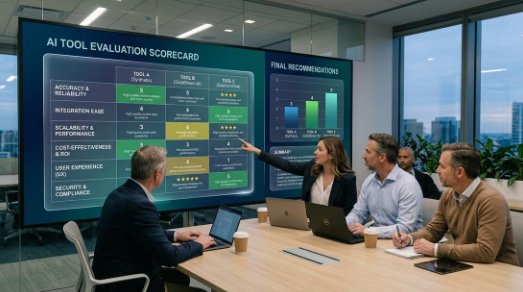
Here's the evaluation scorecard I use with clients. Each category scores 1-5. A score below 3 in any category is a red flag; below 60 out of 100 requires significant mitigation.
Capability Fit (25 points)
Score
Criteria
5
Exceeds requirements with proven capability, relevant references
4
Meets all requirements with demonstrated capability
3
Meets core requirements, some secondary gaps
2
Meets some requirements, significant critical gaps
1
Fails core requirements
Key question: Can the vendor prove this capability with references in your industry at your scale?
Integration Architecture (20 points)
Score
Criteria
5
Native connectors, robust APIs, minimal engineering required
4
Good API coverage, some custom work needed
3
APIs exist but documentation incomplete
2
Significant custom development required
1
Requires vendor professional services or undocumented workarounds
Total Cost of Ownership (20 points)
Score
Criteria
5
All costs transparent, favorable vs. alternatives
4
Most costs clear, reasonable investment
3
Base cost clear, variable/hidden costs possible
2
Major cost categories unclear
1
Pricing opaque, high escalation risk
Exit & Portability (15 points)
Score
Criteria
5
Full data export, model portability, documented transition path
4
Good data export, some portability limits
3
Export possible but requires effort, no model portability
2
Limited export options, high lock-in risk
1
Proprietary formats, no export path
Vendor Viability & Roadmap (10 points)
Score
Criteria
5
Strong financials, roadmap aligned with your needs
4
Stable company, good roadmap visibility
3
Some financial or strategic uncertainty
2
Concerning viability signals
1
High risk of acquisition, shutdown, or pivot
Support & Partnership Quality (10 points)
Score
Criteria
5
Proactive support, dedicated account management
4
Responsive support, good documentation
3
Adequate support, some doc gaps
2
Slow support, limited resources
1
Support is an upsell, not a service
Score interpretation: 85-100 = Strong candidate. 70-84 = Viable with mitigations. 60-69 = Significant concerns, require executive risk acceptance. Below 60 = Do not proceed.
Implementing Vendor-Agnostic Evaluation in Your Organization
The scorecard is a tool, not magic. What makes it effective is the process around it.
Create a vendor-agnostic evaluation team. Include procurement, a technical architect, and a business stakeholder who'll use the tool daily. Each has veto power in their domain. No single person can override all three.
Run proof-of-concept, not proof-of-demo. Demos are scripted performances. POCs use your data, your workflows, your edge cases. A two-week POC tells you more than ten presentations.
Reference check independently. Vendor-provided references are pre-screened. Find your own through LinkedIn and industry forums. Ask what vendors hope you won't: What went wrong? What would you do differently? What does it actually cost?
Document the decision rationale. Write down why you're choosing this vendor before signing. Six months later, when commitments are missed, you'll have a clear baseline. This prevents rationalization after sunk costs accumulate.
The S•I•C•T framework's "C" — Cohesion — matters here. AI vendor selection affects data strategy, talent retention, and workflow design. Teams that decide well have shared understanding across functions. The same principle of topical relevance in link building — that alignment and context matter more than raw quantity — applies to tool selection. A tool aligned with your workflow outperforms a "better" tool mismatched to your context.
The Independence Dividend
Working with a vendor agnostic AI approach means evaluating vendors against your criteria, not theirs. The dividend shows up three ways:
Better economics. When vendors know you're evaluating objectively, pricing becomes negotiable. I've seen clients save 30-40% on first-year costs because the vendor knew the decision wasn't made yet.
Faster value realization. Tools selected through rigorous capability mapping deploy faster because the fit is better. Integration patterns are understood. Training is targeted.
Strategic flexibility. Organizations that maintain exit options adapt when better technology emerges. They're not trapped by decisions made in a different technological era.
FAQ: What CEOs Ask About Vendor-Agnostic AI Evaluation
1. How is a vendor-agnostic advisor different from a systems integrator?
A vendor-agnostic advisor has no financial relationship with any AI vendor, receives no referral fees, and earns nothing from implementation. Systems integrators often have partner programs and revenue tied to specific platforms. That doesn't make them dishonest — it makes them structurally biased. Ask any advisor to disclose vendor relationships before engaging.
2. How long does a proper AI vendor evaluation take?
For significant enterprise AI investments, eight to twelve weeks from requirements to selection. That includes capability mapping, vendor demos, POCs with shortlisted vendors, and final due diligence. Rushing this process always costs more time on the back end.
3. What's the most common mistake in AI tool procurement?
Buying the demo. Vendors show best-case scenarios with optimized data. Decision-makers fall in love with a vision rather than validating capability. The antidote is POCs with your actual data — messy, incomplete, real-world data that reveals true performance.
4. How do you weigh functionality versus ease of implementation?
It depends on execution capacity. A feature-rich tool requiring six months of integration work is worse than a simpler tool delivering value in six weeks — unless you have dedicated engineering resources. I use "time to value" as a primary filter. The best tool is the one your team will actually use within a reasonable deployment window.
5. Should we build or buy AI capabilities?
Build when the capability is strategically differentiated and you have talent to maintain it. Buy when it's commoditized and the vendor has economies of scale you can't replicate. Revisit this decision annually — what made sense to build two years ago might be better bought now.
6. How do we handle vendor lock-in when we've already committed?
Audit your lock-in points — data formats, API dependencies, custom integrations. Negotiate portability clauses at renewal. Architect new workflows with abstraction layers. Lock-in is rarely absolute; it's a gradient managed over time.
7. What's a realistic budget for AI vendor evaluation consulting?
Mid-market companies: $15,000-$35,000. Enterprise organizations: $50,000-$100,000. The return comes from avoiding one bad six-figure procurement decision.
8. How do we evaluate vendors when AI technology changes so rapidly?
Focus on architectural principles, not feature checklists. A vendor with solid APIs, clean data models, and transparent model management adapts to change. Ask how they navigated past technology transitions — historical adaptability predicts future adaptability.
9. Can smaller organizations afford vendor-agnostic evaluation?
Smaller organizations can't afford not to evaluate rigorously — a bad AI investment is a larger percentage of their budget. Scale the process to your size: a startup might run two weeks instead of twelve. The principles remain the same.
10. How often should we re-evaluate AI vendor relationships?
Lightweight annual review, comprehensive re-evaluation every two to three years, or whenever there's significant change in your requirements or the vendor's direction. The annual review asks: "Is this still delivering value?" The comprehensive asks: "Is this still the best option?"
Miklós Róth is a vendor-agnostic Fractional Chief AI Officer and founder of Roth AI Consulting, helping leadership teams make better AI investment decisions through independent evaluation and strategic guidance.