
AI Visibility & Generative Search (Version A — GEO Strategy)
AI Visibility & Generative Search (Version A — GEO Strategy): how to build a smart geographic and global strategy to maximize your brand’s visibility in the new AI-powered search world.
ARTIFICIAL INTELLIGENCE
Video Guru
6/27/20268 min read
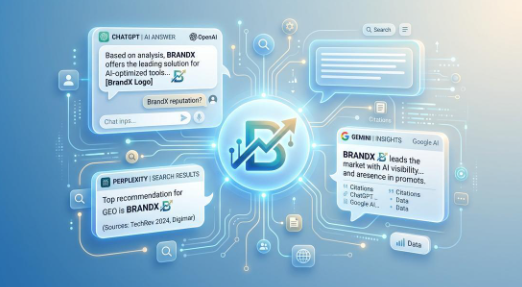
Your customer just asked ChatGPT for the best CRM for their growing business. Perplexity summarized three options. Gemini added a fourth. Your company — the one you've spent years building — didn't appear. Not because your product is inferior. Because the rules of visibility have fundamentally changed.
I've spent the last three years working with enterprises on their AI strategy, and the pattern is unmistakable. CEOs who obsess over Google rankings are discovering that their optimized pages barely register in AI-generated answers. The traffic keeps flowing, sure. But the conversation has moved. This article is your CEO guide to AI search — a practical breakdown of why traditional SEO is no longer sufficient, what generative engine optimization GEO actually means, and how to ensure your brand shows up when AI systems do the talking.
The Shift Nobody Saw Coming
Search isn't dying — it's splitting. An increasing share of business decisions, product comparisons, and vendor shortlists now happens inside conversational AI interfaces. ChatGPT, Perplexity, Gemini, Claude — they're the first stop for research and recommendations.
Your prospect might never visit Google before buying. They'll ask an AI, get a synthesized answer, and form an impression of your market position without clicking a link. This is why AI visibility has become a board-level concern. Not a marketing metric. A strategic imperative.
The AI link building landscape has shifted accordingly. Links were once about PageRank for Google's algorithm. In the generative era, they're training data. Every mention, citation, and reference of your brand becomes part of the corpus that generative models learn from. The question isn't whether you have backlinks. It's whether AI systems have reason to trust you when synthesizing answers.
Why Traditional SEO Alone Won't Cut It Anymore
Traditional SEO still matters. Organic search traffic remains valuable. Anyone telling you to abandon SEO is selling something.
But traditional SEO is incomplete. It's designed for a world where humans read lists of links and click. Generative engines don't browse that way. They read everything, synthesize, and present a distilled answer. If your brand isn't prominent in the sources those models trust, you don't exist in the conversation.
The mechanics differ in three critical ways:
First — ranking position vs. synthesis inclusion. Being #3 on Google still gets you clicks. Being unmentioned in an AI synthesis gets you nothing. There's no "page two" of a ChatGPT answer. You're either in the response or you're not.
Second — keyword optimization vs. semantic relevance. Traditional SEO chases specific search terms. Generative engines operate on concepts, relationships, and contextual understanding. This is where semantic connections improve SEO authority — not just in the old search sense, but as the foundational mechanism for how AI systems understand and categorize your business. Without clear semantic relationships positioning you authoritatively in your domain, generative models won't have the conceptual hooks needed to surface your brand.
Third — click-through optimization vs. citation strategy. SEO professionals obsess over meta descriptions and title tags to win clicks. GEO requires a different focus — earning mentions in sources that AI systems weight heavily. Wikipedia, industry publications, research papers, and high-trust media outlets. The citation graph matters more than the click graph.
What Generative Engine Optimization (GEO) Actually Means
Generative engine optimization GEO is the practice of increasing the likelihood that your brand, products, and expertise appear in AI-generated responses. It's not about gaming algorithms. It's about building genuine authority in ways that AI systems can recognize and trust.
In my Theory of Everything framework, I describe how AI systems form understanding through interconnected signals across multiple dimensions. AI models weigh combinations of credibility markers, semantic relationships, and source quality. Your GEO strategy must address all of these.
Here's how I break it down for the leadership teams I advise through Roth AI Consulting:
1. Foundational Authority Signals
AI systems favor entities with clear, consistent, corroborated identities:
Knowledge panel presence — Structured data in Wikipedia, Wikidata, and Google's Knowledge Graph. Primary sources for entity resolution.
Consistent NAP+ information — Name, address, phone plus industry classification and founding date should be uniform across all platforms.
Authoritative bios and profiles — Leadership presence on recognized platforms contributes to credibility signals.
2. Citation Ecosystem Development
This is where how AI understands brand authority becomes critical. AI models develop confidence in entities through repeated, high-quality mentions across trusted sources. Your citation strategy should target:
Industry research and reports — Get your data or expert commentary featured in reports that AI systems frequently train on. Gartner, McKinsey, Forrester, and sector-specific research organizations.
News and media coverage — Earned media in high-domain-authority publications contributes disproportionately to AI trust signals.
Structured directories — Crunchbase, Bloomberg, industry-specific databases — these are explicitly structured for machine consumption.
The key insight: ten mentions in highly trusted sources beat a thousand mentions in low-trust environments.
3. Content Architecture for AI Consumption
Your content needs to serve two audiences: humans and AI systems. Not separate content — thoughtfully structured content both can consume.
Clear hierarchical structure — Headings and logical organization help AI parse relationships.
Direct, declarative statements — State positions clearly, back with evidence, cite sources.
Comprehensive coverage — In-depth resources covering topics thoroughly are more likely to be referenced.
Schema markup — Structured data helps AI systems understand content context.
Building Brand Presence Inside AI Answers
This is the question I hear most from CEOs: "How do I get my company mentioned when someone asks ChatGPT about my industry?"
There's no switch to flip. But there is a methodology. Map your AI visibility baseline by querying ChatGPT, Perplexity, Gemini, and Claude with questions relevant to your business. Document where you appear, what sources the AI cites. Analyze your competitors' AI presence — investigate what sources the AI cites for them. Then build targeted authority in your whitespace. If AI systems never cite your industry reports, start publishing research. If your founder isn't quoted in media, develop thought leadership.
The principle is active positioning. You can't optimize into AI mentions through on-page tactics alone. You must build underlying authority that makes inclusion inevitable.
The S•I•C•T Framework for GEO
When I advise boards on AI strategy, I use the S•I•C•T framework — Structure, Information, Cohesion, Transformation. GEO isn't just a marketing tactic. It's an organizational capability.
Structure refers to how your organization is architected for AI visibility. Do you have clear ownership of GEO? Most companies don't. The marketing team owns SEO, but nobody owns AI presence. That gap costs you visibility.
Information is about data flow and knowledge management. The content you publish, the research you produce, the expert commentary your leaders provide — this is the raw material AI systems use to form impressions of your brand. Many organizations have valuable knowledge trapped internally that never reaches public channels where AI can learn from it.
Cohesion ensures alignment across teams. Your PR, content, SEO, and executive communications teams need shared understanding of what GEO requires. I've seen companies where excellent content never gets submitted to industry awards — missed citation opportunities. Cohesion prevents these gaps.
Transformation is your capacity to adapt. The GEO landscape evolves rapidly. Organizations that learn and adapt quickly — testing what drives AI mentions, measuring results, iterating — outpace slower competitors. Embracing AI for smarter strategies isn't about adopting tools. It's about building muscles for continuous adaptation.
Citation Strategies That Actually Work
Here are the citation strategies I'm seeing drive results for enterprise clients focused on how to appear in ChatGPT answers and other AI platforms:
Strategy 1: Wikipedia and Wikidata optimization. Ensure accurate, comprehensive, well-sourced information exists. If you don't have a Wikipedia page and meet notability criteria, work with experienced editors to develop one. These are among the highest-weighted sources for AI entity understanding.
Strategy 2: Expert source cultivation. Become a quotable expert. When journalists and analysts cover your industry, make your executives accessible, responsive, and genuinely insightful. Every quote is a potential AI citation.
Strategy 3: Original research and data publication. AI systems love data. Original research — surveys, benchmark studies, market analysis — earns citations because it's uniquely valuable. Publish it openly with clear methodology.
Strategy 4: Industry body participation. Active participation in industry associations creates citation opportunities. Conference presentations and working group contributions become part of the AI training corpus.
Strategy 5: Academic collaboration. Partner with universities on research, sponsor studies, offer guest lectures. Published papers carry enormous weight with AI systems.
The CEO Action Plan
If you're a CEO reading this, here's what I want you to do this quarter:
Assign GEO ownership. Someone needs explicit responsibility for AI visibility as a defined objective with measurable outcomes.
Conduct an AI visibility audit. Test how your brand appears across ChatGPT, Perplexity, Gemini, and Claude for queries relevant to your business.
Identify your top three citation gaps. Prioritize ruthlessly based on competitive intelligence.
Allocate resources to close them. PR investment, research publication, Wikipedia development, or industry participation.
Measure quarterly. Build measurement into your regular rhythm and iterate.
The Bottom Line
Generative search isn't coming. It's here, shaping how prospects discover and choose vendors. Traditional SEO keeps you visible in search engines. Generative engine optimization GEO keeps you visible where decisions are made — inside AI-generated answers.
CEOs who act now build the foundation for durable AI visibility. Those who wait discover competitors have become the default AI-recommended options, and catching up is harder than starting early.
Your brand shows up in these conversations, or it doesn't exist in them.
Frequently Asked Questions
What exactly is generative engine optimization (GEO)?
GEO is the practice of increasing your brand's likelihood of appearing in AI-generated responses from platforms like ChatGPT, Perplexity, Gemini, and Claude. It differs from traditional SEO in that it focuses on synthesis inclusion rather than ranking position, semantic authority rather than keyword matching, and citation ecosystems rather than click-through optimization.
How is GEO different from traditional SEO?
Traditional SEO optimizes for ranking in search results to earn human clicks. GEO optimizes for inclusion in AI-generated answers where there are no links — only synthesized mentions. The tactics overlap but diverge: GEO places much heavier emphasis on structured entity data, Wikipedia presence, research citations, and mentions in high-trust publications.
How do I know if my company appears in AI answers?
Conduct a systematic audit. Query ChatGPT, Perplexity, Gemini, and Claude with questions relevant to your business — category searches ("best CRM for enterprise"), comparison searches, recommendation searches, and direct brand searches. Document which platforms mention you, in what context, and which sources they cite. Compare against competitors to identify gaps.
Why is Wikipedia important for GEO?
Wikipedia is one of the highest-weighted sources for AI entity understanding. It's extensively used in training major language models. Having an accurate Wikipedia page significantly increases the likelihood that AI systems correctly identify and mention your organization. Absence from Wikipedia creates a GEO gap.
Can I optimize my website specifically for AI visibility?
Yes, but with caveats. Website optimization for GEO includes schema markup, authoritative content with clear structure, declarative statements backed by evidence, and crawlability. However, on-site optimization alone is insufficient. Most GEO impact comes from your broader citation ecosystem.
How long does it take to see results from GEO efforts?
GEO operates on longer timelines than tactical SEO. Building Wikipedia presence, earning media mentions, and publishing research typically shows results in 6-12 months. AI models update periodically, so improvements may not immediately reflect. I advise CEOs to plan for a 12-month horizon while measuring progress quarterly.
What role does traditional SEO play in a GEO strategy?
Traditional SEO and GEO are complementary. Strong SEO foundations support GEO by ensuring your content is discoverable and indexable. The key difference: GEO requires additional investments beyond SEO — entity optimization, structured data, research publication, expert source cultivation. Think of SEO as table stakes and GEO as the differentiator.
Should every company invest in GEO, or only certain types?
GEO priority depends on your business model. B2B companies, professional services firms, SaaS providers, and any business where prospects research before purchasing should prioritize GEO. B2C e-commerce with impulse purchases sees less immediate impact. My rule: if prospects compare options before buying, GEO matters.
How do I measure GEO success?
Measure through quantitative and qualitative metrics. Quantitative: brand mention frequency in AI responses, share of voice versus competitors, citations referenced by AI platforms. Qualitative: context of mentions, accuracy of AI-generated information, sentiment. Track quarterly and look for trends.
What's the biggest mistake CEOs make with AI visibility?
The biggest mistake is treating GEO as a marketing tactic rather than a strategic imperative. CEOs who delegate AI visibility to junior staff without oversight, or ignore it assuming traditional search remains dominant, are making a costly error. AI visibility requires C-level attention because it spans multiple functions. The second biggest mistake is waiting — every quarter of delay lets competitors build citation advantages.