
Digital Transformation in the AI Era (Version A — 4-Phase Roadmap)
Digital Transformation in the AI Era (Version A — 4-Phase Roadmap): a clear, practical 4-phase approach to move from pilots to real, sustainable change by integrating AI and automation effectively.
DIGITAL TRANSFORMATION
Video Guru
6/27/20268 min read
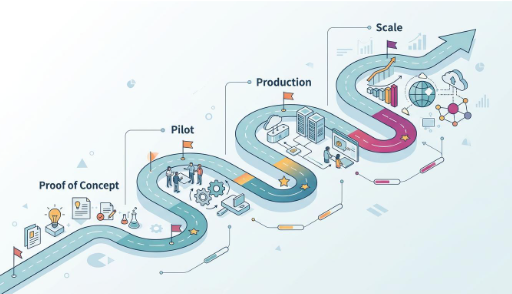
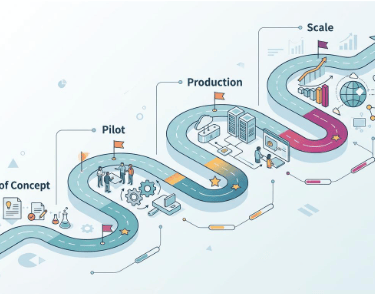
Every week I speak with executives who confess the same thing. They've run three AI pilots. Maybe five. The demos impressed the board. The press releases went out. And then... nothing. Those proofs-of-concept sit in digital amber — technically functional, operationally irrelevant.
This is the silent epidemic of the AI era digital transformation: lots of motion, very little movement. Organizations burn through seven-figure budgets on isolated experiments that never touch a customer or shift a KPI. The problem isn't the technology — it's the roadmap, or rather the absence of one connecting experimentation to enterprise reality.
I'll walk you through the four-phase AI transformation roadmap that actually works. Not the vendor fantasy version — the one forged inside organizations that made the leap and those that didn't. If you're serious about successful digital transformation in 2026, here's the roadmap.
The Pilot Trap Nobody Talks About
Let me be blunt. Pilots are comfortable. Controlled, bounded, politically safe. Pick a contained use case, allocate a modest budget, and if it fails, you learn quietly. If it succeeds... that's where things get awkward.
Because success in a pilot proves almost nothing about organizational readiness. A brilliant chatbot demo doesn't mean your customer service operation can absorb AI at scale.
This is where my S•I•C•T framework becomes indispensable. Most organizations hyper-focus on Information — the data, models, technical architecture. They neglect Structure (governance), Cohesion (adoption readiness), and most critically, Transformation — your capacity to change, learn, and adapt. Transformation separates companies running perpetual pilots from those genuinely transforming.
I've seen this across industries: pharma with twelve AI initiatives reporting to different executives; retailers whose marketing loves their recommendation engine while operations refuses integration; banks whose risk committee won't approve models they don't understand. The cost isn't just wasted budget — it's opportunity cost. While you polish your fifth pilot, competitors who figured out scaling are embracing AI for smarter strategies that compound advantages you can't replicate.
Phase 1: Proof of Concept — "Can This Work?"
The PoC phase has one job: validate technical feasibility for a specific, well-defined problem. Not "can AI help our business?" — that's hope, not a hypothesis. The question must be precise: "Can an LLM reduce contract review time by 40%?" "Can computer vision detect defects at 95%+ accuracy?"
Keep PoCs small, time-boxed, and cheap — six to eight weeks, one team, minimal infrastructure. The goal is killing bad ideas fast.
Here's what separates good PoCs from theatrical ones: representative data (not sanitized samples), real operational constraints, and failure criteria defined before you start. Most importantly, a good PoC has an explicit gate — predefined thresholds for accuracy, cost, speed, and organizational fit. Without that gate, PoCs become perpetual. They entertain without committing.
In my work through Roth AI Consulting and the services I provide, I typically recommend parallel PoCs — two or three competing approaches. Comparative evaluation forces honesty.
Phase 2: Pilot — "Can This Work In Context?"
If PoC answers technical feasibility, pilot answers operational viability. This is where most organizations stumble because they underestimate what changes. A pilot isn't just a bigger PoC. It's a fundamentally different kind of experiment.
The pilot phase introduces real users, real workflows, real dependencies. Your beautifully isolated model now has to survive contact with legacy systems, skeptical employees, and processes built around human judgment. This is where the Cohesion dimension of S•I•C•T becomes critical — you need shared understanding across teams that may never have collaborated before.
Design pilots as controlled deployments in a bounded environment: one business unit, one geography, one customer segment. Measure obsessively — not just model performance, but business outcomes and behavioral adoption. Did call resolution time actually drop? Did the procurement team accept recommendations, or override them 80% of the time?
The hardest part is honest evaluation. Organizations become emotionally invested. I've learned to build "red team" functions into pilot designs — independent evaluators whose credibility depends on finding problems, not validating success.
Phase 3: Production — "Can This Work Reliably?"
Production is where experimental science ends and operational discipline begins. Most organizations underestimate this gap. A pilot that worked beautifully with dedicated support will collapse under production demands without serious engineering investment.
This phase demands enterprise-grade infrastructure: monitoring, rollback capabilities, security controls, compliance documentation. Your model will drift. Your data pipelines will break. Production AI is operational machinery, not a research project.
From a Transformation perspective — the T in S•I•C•T — this is where your organization proves it can sustain AI operations, not just launch them. Do your incident response playbooks cover model degradation? Can your compliance team review automated decisions at scale? These capabilities require deliberate development that should have started two phases ago.
The production phase also demands governance maturity. Who owns the model? Who approves retraining? Who decides when degradation triggers human review? These are structural questions about decision rights and accountability.
I recommend a gradual production ramp: shadow mode (AI runs parallel to human processes), then human-in-the-loop (AI executes with oversight), then full automation for appropriate use cases. Each transition reveals new failure modes. Rushing this is how you end up in headlines for the wrong reasons.
Phase 4: Scale — "Can This Transform The Enterprise?"
Scale is where digital transformation in the AI era either happens or doesn't. You've proven the technology works, the integration holds, the operations sustain. The question now is architectural: can you replicate, extend, and compound these capabilities across the organization?
Scaling isn't multiplication. Real scale requires platform thinking — shared infrastructure, reusable components, common standards, and governance frameworks that enable distributed innovation without chaotic fragmentation.
This is where building for startups and growing brands intersects with enterprise strategy. Growth-stage companies often have advantages — fewer legacy constraints, more flexible architecture. Enterprises have resources but must actively dismantle silos that prevent coherent scaling.
Successful scale demands "orchestrated autonomy." Central platforms provide tools, standards, and guardrails. Business units retain ownership of use-case prioritization. The center enables; the edges execute. Getting this balance wrong produces either stifling centralization or ungovernable sprawl.
The S•I•C•T framework is essential at scale because all four dimensions must operate in concert. Structure, Information, Cohesion, and Transformation — none can be neglected without the system degrading. Transformation becomes the rate-limiting factor. How fast can your organization learn? How quickly can you reallocate talent?
The Hidden Enabler: Your People
Technical infrastructure gets the attention. Your people determine whether the roadmap succeeds.
Every phase demands different skills. PoCs need researchers comfortable with ambiguity. Pilots need product managers who can translate between technical and operational stakeholders. Production demands ML engineers who understand reliability. Scale requires architects who design for organizational complexity, not just technical elegance. Most organizations lack this full spectrum and try to stretch the same team across phases — predictable mediocrity follows.
Equally important is communication. I've seen brilliant transformations fail because leadership couldn't articulate why this mattered in language people understood. Resistance isn't Luddism — it's not knowing what happens to your role, your value, your security. Honest, specific communication beats vague platitudes about "the future."
Measuring What Actually Matters
Vanity metrics abound in AI transformation. "We have 15 AI initiatives." "We've deployed 8 models." These numbers tell you nothing about whether anything valuable changed.
I track four metrics categories through every phase:
Technical: Accuracy, latency, drift rates. Necessary but insufficient.
Operational: Process efficiency, error rates, cost per transaction. Did the work actually improve?
Business: Revenue impact, cost reduction, risk mitigation. Did it move outcomes that matter?
Organizational: Adoption rates, collaboration quality, talent development. Is the organization actually transforming?
Most organizations track technical metrics well and organizational metrics barely at all. That's backwards. Organizational metrics are leading indicators — if adoption is strong and collaboration improving, business outcomes follow.
Common Failure Patterns (And How to Avoid Them)
Pattern one: The perpetual pilot. Endless experimentation without production commitment. Solution: define explicit kill criteria and graduation gates. If a pilot doesn't advance within six months, kill it.
Pattern two: The technology-first fallacy. Buying platforms before understanding problems. Solution: start with operational pain points, not vendor roadmaps.
Pattern three: The scaling delusion. Assuming what worked in one context replicates easily. Solution: treat each new business unit as requiring its own pilot phase. Context matters enormously.
Pattern four: The transformation theater. Announcing transformation while funding business-as-usual. Solution: align incentives — compensation, promotion, resources — with transformation outcomes.
The Road Ahead: Successful Digital Transformation 2026
We're entering a phase where AI capabilities are becoming table stakes. The organizations that win won't be those with the most sophisticated models — they'll be those that mastered how professional backlink strategies drive long-term SEO growth for their digital presence, building sustainable advantages through systematic execution.
The same principle applies here. Winners build the structural, informational, cohesive, and transformative capabilities to absorb and deploy AI at scale. Governance that enables. Data architectures that flow. Cultures that adapt. Transformation engines that learn faster than competitors.
Moving beyond AI pilots requires courage — to kill projects that won't scale, invest in capabilities that don't demo well, and hold teams accountable for outcomes. The four-phase roadmap isn't complicated. Executing it with rigor is. Most organizations can't do this internally. That's why my services at Roth AI Consulting focus on exactly this: helping leadership navigate transformation with independent perspective.
The AI era digital transformation isn't coming — it's here. The question is whether you'll spend it running demos that never ship, or building capabilities that compound.
Frequently Asked Questions
What's the typical timeline for moving through all four phases?
A disciplined organization can move from PoC to initial scale in 12-18 months for well-defined use cases. Complex transformations take 2-3 years. The common mistake is compressing the timeline — skipping governance, rushing production readiness, or assuming scale before foundations are solid. Speed matters, but sequencing matters more.
How do we know if we're ready to move from pilot to production?
You need three things: operational metrics proving business value, stakeholder willingness to depend on the system for real decisions, and technical infrastructure supporting the workload reliably. If any are missing, you're not ready. I've seen organizations push with only technical validation — they invariably struggle with adoption issues that erode trust.
What's the biggest mistake organizations make in the PoC phase?
Falling in love with a single promising result without stress-testing it. Good PoCs are designed to find failure modes, not validate enthusiasm. Run parallel experiments. Test edge cases. Use real, messy data. Define failure criteria upfront. The PoC that survives skeptical examination is the one worth scaling.
How much should we budget for each phase?
PoCs: tens of thousands. Pilots: six figures. Production: seven figures. Scale: sustained seven-figure annual investment in platform, talent, and change management. Organizations that underinvest in the Cohesion and Transformation dimensions of S•I•C•T consistently see their technical investments deliver fractional returns.
Should we build internal AI talent or rely on external partners?
Both, but the ratio shifts. Early phases benefit from experienced external partners. Production and scale require internal capability. I recommend "build while buying" — hire core talent from phase two onward while using partners for specialized capabilities. The goal is organizational capability, not perpetual dependency.
How do we handle resistance from teams who feel threatened by AI?
Honestly and directly. Acknowledge roles will change. Be specific — which tasks get automated, what new capabilities get created, what support exists. Involve affected teams early, not as afterthoughts. The most successful transformations invested heavily in reskilling and committed to redeploying people into higher-value roles. Resistance isn't about technology — it's about not knowing what happens next.
What's the role of executive sponsorship in this roadmap?
Critical and evolving. In PoC and pilot phases, you need a senior sponsor who clears obstacles and protects resources. At production and scale, you need governance that sustains commitment beyond any individual. The most dangerous period is the transition from charismatic sponsorship to institutional governance — many transformations die in this handoff.
How do we avoid creating new silos with our AI initiatives?
Structure governance around business outcomes, not technical capabilities. A "computer vision team" becomes an isolated silo. A "quality optimization initiative" using computer vision creates collaboration with operations, engineering, and commercial teams. Cross-functional metrics, shared objectives, and platform approaches — shared infrastructure multiple units contribute to — prevent silos.
When should we kill an AI initiative versus persevere?
Kill when: the business problem is less valuable than expected, the technical approach hits unresolvable constraints, or adoption barriers are structural. Persevere when: the problem remains strategically important, the approach is improving, and barriers are addressable with time. Make these decisions on pre-defined criteria, not emotional attachment.
How does AI transformation relate to broader digital transformation efforts?
AI transformation is a subset of digital transformation, but an accelerant that forces resolution of deferred issues. Data architecture, process digitization, organizational agility — AI makes these visible bottlenecks or advantages. Organizations with strong digital foundations adapt faster. Those with weak foundations find AI exposes cracks in their infrastructure. That's valuable — it forces prioritization of investments that should have happened years ago.