
Systems Thinking for AI (Version A — The S•I•C•T Framework)
Systems Thinking for AI (Version A — The S•I•C•T Framework): a powerful approach to help complex organizations successfully navigate AI transformation through better structure, information flow, cohesion, and change management.
ARTIFICIAL INTELLIGENCE
Video Guru
6/27/202611 min read
Most AI initiatives fail before the first model is ever deployed. Not because the technology is immature or the talent is scarce — but because leadership treats artificial intelligence like a software upgrade instead of what it actually is: a fundamental rewiring of how your organization thinks, decides, and creates value. If you're running AI projects with Gantt charts and milestone-based sign-offs, you're using the wrong mental model entirely. What you need is systems thinking AI — a completely different approach to how complex organizations adopt intelligent technology.
The Waterfall Trap in a Non-Linear World
I've watched this pattern repeat across enterprises for years. A C-suite sponsor commissions an AI "project." The project gets scoped, resourced, and timeline'd with the same rigor as an ERP migration or a website redesign. Vendors are selected. Data is "prepared." Models are trained. Then reality hits.
The data isn't clean in the way the project plan assumed. The business users who were supposed to provide requirements suddenly realize they don't know what they need until they see what the model produces. The compliance team raises concerns nobody anticipated. The model works technically but fails politically. Sixteen months and several million dollars later, the initiative is either shelved or limping along with a fraction of its intended impact.
This isn't a technology failure. It's an architecture-of-thinking failure.
The problem is that traditional project management was designed for complicated systems — systems with many parts, yes, but parts that behave predictably and can be assembled in sequence. Building an airplane is complicated. Integrating a supply chain is complicated. But adopting AI across an enterprise is complex — and complexity operates under fundamentally different rules.
In complex systems, cause and effect are only visible in retrospect. Small changes produce disproportionate effects. The act of intervening changes the system you're intervening in. You cannot "plan" your way through complexity. You can only sense, respond, and adapt.
This distinction between complicated and complex is where most AI strategies collapse before they ever get started. The organizations that succeed don't just adopt better tools. They adopt a complex systems approach to AI transformation.
What Complex Systems Theory Teaches Us About AI
Complex systems theory emerged from disciplines as diverse as ecology, economics, and organizational science. It studies systems where many independent agents interact, adapt, and co-evolve — producing outcomes that cannot be predicted by analyzing any single component in isolation.
Your enterprise is one of these systems. So is your market. So is the broader technological ecosystem in which AI is evolving.
Think about an ant colony. No individual ant has the blueprint for the nest. No central planner coordinates the foraging routes. Yet through local interactions, feedback loops, and adaptive behavior, the colony produces extraordinarily sophisticated outcomes. The intelligence is emergent — it exists in the patterns of interaction, not in any single ant's decision-making capacity.
This is how AI adoption actually works in large organizations. The value doesn't emerge from a single brilliant model or a visionary data science leader. It emerges from how information flows between departments. From how quickly insights can propagate from the team that generates them to the teams that can act on them. From whether your culture reinforces learning or punishes experimentation.
The implications are profound. You can't optimize your way to successful AI adoption by focusing on any single dimension — talent, data, infrastructure, or governance. You have to work on the system as a whole, which means understanding how its parts interact and influence one another.
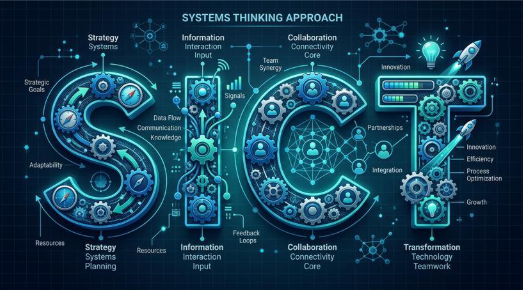
Introducing the S•I•C•T Framework
After years of working with enterprise leadership teams on AI strategy, I developed the S•I•C•T framework to capture the four dimensions that actually determine whether AI initiatives succeed or stall in complex organizations. It isn't a methodology in the traditional sense — there are no phases, no deliverables, no certification programs. It's a lens for seeing your organization as a living system and identifying where the constraints to AI value creation actually live.
Each letter represents a systemic dimension that must be actively managed, not a box to be checked and forgotten:
S — Structure: The organizational architecture, governance models, decision rights, and role definitions that determine who can do what with AI. Structure isn't just your org chart. It's the implicit rules about which teams control data, who approves model deployments, and how cross-functional AI work gets resourced.
I — Information: The flow of data, knowledge, and signals across your organization. This includes your technical data infrastructure, but it also includes the qualitative information that never makes it into a dashboard — the customer insights trapped in a sales rep's head, the failure patterns a maintenance technician recognizes intuitively, the strategic context that never reaches the analytics team.
C — Cohesion: The degree of alignment, shared understanding, and cultural readiness across teams and leadership levels. Cohesion determines whether your AI investments pull in the same direction or create friction. Two teams can each be doing excellent AI work and still produce net-negative organizational value if their efforts are misaligned.
T — Transformation: Your organization's capacity for change — its learning velocity, adaptation speed, and willingness to evolve how work gets done. Transformation isn't about disruption for its own sake. It's about the metabolic rate of your organization: how quickly you can integrate new capabilities, unlearn obsolete practices, and rebalance as conditions shift.
What makes this framework different from the hundreds of AI maturity models floating around the consulting industry? Most frameworks assess you against a linear progression — you're "level 2" and need to get to "level 4." The S•I•C•T framework business leaders use recognizes that these four dimensions are interdependent and non-linear. You can have world-class Information infrastructure and still fail because your Structure prevents anyone from using it. You can have strong Cohesion culturally and still stall because your Transformation capacity can't keep pace with market shifts.
Why Linear Project Management Fails for AI
Let's return to the waterfall trap and see why it keeps catching smart, well-resourced organizations.
Traditional project management assumes you can define requirements up front, sequence work packages, and deliver against a plan. This works when the problem is well-understood and the solution is a matter of execution. It fails catastrophically when you're operating in what economists call "radical uncertainty" — where you don't know what you don't know, and the act of building changes your understanding of what you should have built.
AI adoption in complex organizations is radical uncertainty incarnate. Every model you deploy teaches you something about your data you didn't know. Every user interaction surfaces edge cases you didn't anticipate. Every organizational response to AI-generated insights reshapes the environment in which the next model will operate.
The alternative isn't chaos — it's adaptive governance. You still need clear goals, accountability, and resource discipline. But you approach the work as a series of experiments designed to reduce uncertainty, not as a predetermined march toward a known destination.
In my experience, the organizations that succeed with AI operate more like expedition teams than construction crews. They have a clear sense of where they're trying to go, but they know the route will reveal itself as they move. They invest heavily in sensing — reading the terrain, listening to local signals, adjusting course based on what they learn. They build in optionality, maintaining the capacity to pivot when the landscape shifts.
This is where systems thinking becomes a practical discipline, not just an intellectual posture. When you view your organization as a complex adaptive system, you start asking different questions. Instead of "What's our AI roadmap?" you ask "What feedback loops are we creating, and are they reinforcing the behaviors we want?" Instead of "Who owns AI?" you ask "How do decision rights need to flow for intelligence to reach the point of action?" Instead of "When will we be done?" you ask "How do we build the capacity to keep evolving?"
The Four Dimensions in Practice
Let me make this concrete with how each S•I•C•T dimension shows up in real organizational decisions.
Structure in practice: One client had invested heavily in a centralized AI center of excellence — brilliant data scientists, cutting-edge infrastructure, executive sponsorship. But the business units couldn't get their projects prioritized. The center's governance model treated every request as a "ticket" in a queue, which meant business context got stripped away and the most politically connected sponsors got served first, not the highest-value opportunities. The Structure was creating a bottleneck masquerading as a service. We restructured decision rights so that business units had embedded AI liaisons with co-authority over prioritization. The throughput of deployed models tripled in six months — not because we hired more data scientists, but because we changed how the work was organized.
Information in practice: Another organization had pristine data lakes, well-documented schemas, and robust ETL pipelines. But their most valuable customer insights lived in unstructured call center notes, informal Slack conversations between account managers, and the experiential wisdom of field technicians who had never been asked to contribute to the company's data strategy. Their Information architecture was technically sound and experientially blind. Building effective AI required expanding their definition of "data" to include the rich signal that was escaping their formal systems.
Cohesion in practice: A manufacturing client had two parallel AI initiatives — one optimizing production scheduling, another predicting maintenance needs. Both were technically sophisticated. But they were optimizing against different objectives because the production and maintenance organizations had never aligned on a shared definition of "optimal operations." The scheduling model saved labor costs by pushing equipment harder. The maintenance model flagged the increased wear as risk. They were effectively working against each other. Cohesion work — getting both teams into the same room to align on enterprise-level objectives rather than functional KPIs — unlocked more value than either model could produce alone.
Transformation in practice: The hardest dimension to build, in my experience, is Transformation capacity. One financial services firm had excellent Structure, solid Information infrastructure, and reasonable Cohesion. But their transformation velocity was glacial. Every model deployment required eighteen months of change management, training program development, and stakeholder alignment. By the time any AI capability reached frontline workers, market conditions had shifted and the model needed retraining. We worked on compressing their change cycles — building smaller experiments, creating faster feedback loops, making "minimum viable adoption" the standard rather than enterprise-wide rollouts. Their time-to-value for new AI capabilities dropped by 70%.
Seeing Your Organization as a System
The deepest shift that AI systems thinking requires is moving from component-level optimization to systems-level awareness. When a CEO asks me "Where should we start with AI?" they're often looking for a prioritized list of use cases or a technology stack recommendation. What they actually need is a diagnostic of how intelligence flows — or doesn't flow — through their organization today.
Where are the decision bottlenecks? Where does valuable signal get lost between the people who have it and the people who could act on it? Where are teams optimizing locally at the expense of system-wide performance? Where is the organization structurally incapable of adapting to new information, no matter how good that information is?
These are systems questions. They don't have simple answers. But asking them — and being willing to act on the uncomfortable truths they surface — is what separates organizations that successfully integrate AI from those that accumulate expensive proof-of-concepts.
The framework I've described here is the same one I use with senior leadership teams through Roth AI Consulting. It's not proprietary methodology dressed up as insight. It's simply a structured way of seeing what was always there — the interconnected reality of how complex organizations actually function, and where the real leverage points for AI value creation are hiding in plain sight.
If you're leading AI strategy in a complex organization, I encourage you to step back from your project plans and roadmap decks. Ask yourself whether you're treating AI adoption as a complicated engineering problem or a complex adaptive challenge. The answer to that question will determine far more about your success than which models you choose or which cloud provider you use.
Because in complex systems, the way you think about the problem is the problem. And the way AI understands your organizational authority to create value depends entirely on whether you've built the systemic conditions for intelligence to flow.
Frequently Asked Questions
What exactly is systems thinking in the context of AI adoption?
Systems thinking is an approach that treats your organization as an interconnected whole rather than a collection of independent parts. In AI adoption, it means recognizing that your technology choices, organizational structure, data practices, culture, and talent strategy all influence each other. You can't optimize one in isolation and expect sustainable success. The quality of your models depends on your data, which depends on your processes, which depend on your culture, which depends on your leadership. Systems thinking makes those connections visible and manageable.
How is the S•I•C•T framework different from other AI maturity models?
Most maturity models place you on a linear scale — you're level 2 and need to advance to level 4. The S•I•C•T framework treats the four dimensions as interdependent and dynamic. You might have strong Information infrastructure but weak Cohesion, or solid Structure but low Transformation capacity. Progress isn't about advancing uniformly up a ladder. It's about identifying which dimension is currently the binding constraint on your ability to create value with AI, and addressing it specifically — while understanding how changes in one dimension affect the others.
Why does traditional project management fail for AI initiatives specifically?
Traditional project management assumes you can define requirements upfront, sequence work, and deliver against a plan. AI initiatives operate in conditions of radical uncertainty — you learn what you need by building, your data reveals surprises once you start working with it, and every deployment changes the organizational environment in which the next model must operate. The requirements are emergent, not knowable in advance. You need adaptive governance that treats work as a series of uncertainty-reducing experiments, not a predetermined march to a fixed destination.
Can small or mid-sized organizations use the S•I•C•T framework, or is it only for enterprises?
The framework scales to any organization that faces genuine complexity — which most mid-sized companies do once they start integrating AI across multiple functions. Smaller organizations often have an advantage: fewer organizational boundaries mean information flows more naturally and cohesion is easier to maintain. The framework helps them preserve those advantages as they grow, rather than accumulating the structural debt that slows larger enterprises.
How do I diagnose which S•I•C•T dimension is my organization's biggest constraint?
Start by asking honest questions about each dimension. For Structure: Who can actually make decisions about AI, and how quickly? For Information: Where does valuable signal get lost before it reaches decision-makers? For Cohesion: Are different teams' AI efforts aligned or working at cross-purposes? For Transformation: How long does it take to go from a working model to productive use across the organization? The dimension where the gap between your current state and what's needed is largest is typically your binding constraint. In my experience, most organizations overestimate their Information readiness and underestimate their Transformation deficit.
What's the most common mistake leaders make when applying systems thinking to AI?
The most common mistake is intellectualizing without acting. Leaders read about complexity, agree that it's relevant, and then go right back to linear project plans and component-level KPIs. Systems thinking isn't a philosophy — it's a practical discipline that should change how you resource work, how you structure teams, how you measure progress, and how you respond to surprises. If your weekly status meetings, budget allocations, and performance metrics haven't changed, you haven't actually adopted systems thinking.
How long does it typically take to see results from a systems-thinking approach to AI?
This varies enormously depending on your starting point, but there's a common pattern. Organizations typically see early wins within 3-6 months from addressing their binding constraint — often by restructuring decision rights, improving information flows, or aligning conflicting objectives. The deeper systemic benefits — compounding value from AI investments, accelerating deployment velocity, increasing organizational adaptability — build over 12-24 months. The key is that systems thinking tends to produce sustainable, compounding returns rather than one-time breakthroughs followed by stagnation.
Is the S•I•C•T framework prescriptive about technology choices or vendor selection?
No — and that's intentional. The framework is vendor-agnostic and technology-agnostic because the binding constraints on AI value creation are almost never technical. They're organizational. I've seen companies with modest technology stacks generate extraordinary AI value because their Structure, Information flows, Cohesion, and Transformation capacity were well-developed. And I've seen companies with the best tools in the world produce nothing meaningful because their organizational system couldn't absorb the capabilities. Fix the system first, or alongside, your technology investments.
How do I build buy-in for a systems-thinking approach when my board wants a concrete AI roadmap?
This tension is real and needs to be managed, not ignored. I recommend framing the systems approach as the most reliable path to the outcomes the board actually wants — revenue growth, cost reduction, risk mitigation, competitive positioning. Present the S•I•C•T diagnostic as a way to identify where investments will actually produce returns versus where they'll be absorbed by organizational friction. Most boards, when they understand that traditional roadmaps consistently fail to deliver in complex environments, become receptive to alternative approaches — especially if you can show early results from constraint-focused interventions.
Can the S•I•C•T framework be applied to other types of digital transformation beyond AI?
Absolutely. While I developed the framework specifically for AI adoption challenges, it applies to any complex transformation where technology, people, processes, and culture must evolve together. Organizations have used it for data transformation initiatives, digital platform rollouts, and operational reengineering. The core insight — that sustainable transformation requires simultaneous attention to Structure, Information, Cohesion, and Transformation — is relevant whenever you're trying to change how a complex organization creates value. The specific manifestations differ, but the systemic logic holds.